
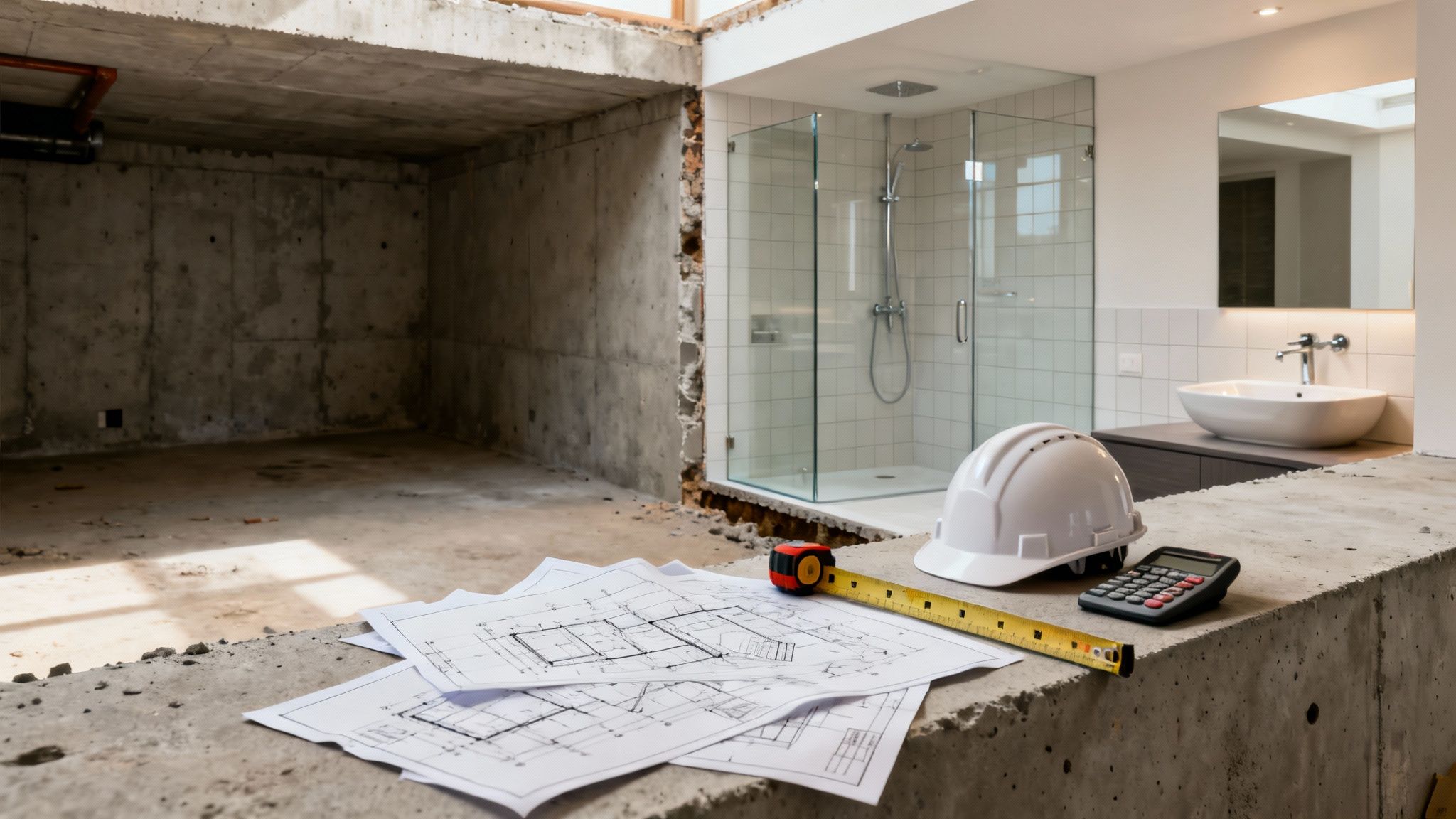
Cost of Basement Remodel with Bathroom: Budget Tips & Real Budgets
Let's get right to the big question on everyone's mind: what's this actually going to cost?
For a basement remodel that includes a new bathroom here in Utah, you're typically looking at a range between $30,000 and $80,000. The bathroom itself is a major part of that investment, often falling somewhere between $8,000 to $16,000 of your total budget, all depending on how simple or luxurious you want to go.
Answering Your Big Question: The Cost to Add a Bathroom
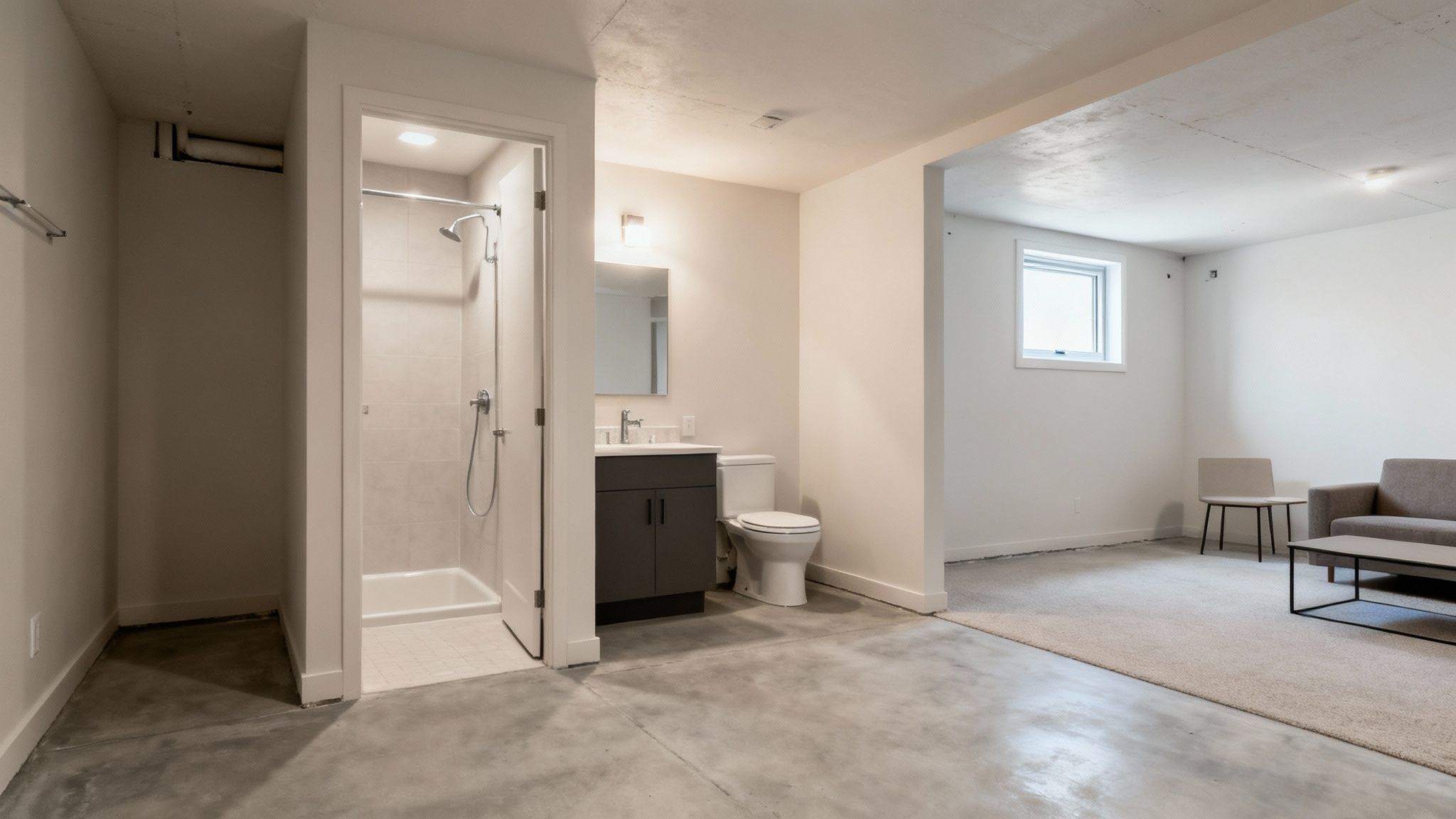
Before you start picking out paint colors, the first step is always getting a handle on the financial side of things. It’s what turns a dream of a finished basement into a real, functional living space. While every project is unique, having a solid baseline budget is absolutely essential for smart planning.
Adding a bathroom instantly makes the project more complex—and more expensive. It's not just about setting a toilet and a sink. It involves serious plumbing, dedicated electrical circuits, and proper ventilation, all of which demand skilled professionals who know how to navigate local building codes.
The payoff, though? A new bathroom delivers one of the best returns on investment you can make in a basement, adding a huge boost to your home's functionality and overall value.
A Clear Financial Snapshot
So, what factors really move the needle on that final price? It really boils down to a few key decisions:
- Project Scope: Are you just finishing a small portion of the basement, or are we talking about the entire lower level with multiple rooms?
- Finish Level: Are you comfortable with standard, builder-grade materials, or are you envisioning high-end tile, custom vanities, and premium fixtures?
- Plumbing Complexity: This is a big one. Does your basement already have plumbing "rough-ins" ready to go? If not, we'll need to cut into the concrete to run new drain lines, which adds significant cost.
On a per-square-foot basis, a bathroom is almost always the most expensive part of a basement finish. Think of it as a mini-project within your main project, requiring careful coordination between plumbers, electricians, framers, and tile setters.
Here in the Provo-Orem area, a standard 1,000-square-foot basement remodel with a full bathroom will generally land in that $30,000 to $80,000 range. The bathroom alone can easily eat up 20-40% of the total budget, which shows you just how much it impacts the bottom line.
Setting a Realistic Budget
To help you get a better feel for where your project might land, we've put together a quick overview of what you can expect at different investment levels. This is a great starting point for figuring out how your vision aligns with a practical budget.
For a more tailored look, check out our free basement finishing cost calculator where you can plug in your own numbers.
Estimated Costs for a Basement Remodel with Bathroom in Utah
| Basic / Entry-Level | $30,000 - $45,000 | $8,000 - $12,000 | Standard finishes, pre-fab shower unit, basic vanity, builder-grade flooring and fixtures. Ideal for functionality. |
| Mid-Range / Quality | $45,000 - $65,000 | $12,000 - $18,000 | Upgraded LVP flooring, tiled shower with glass door, semi-custom vanity with stone countertop, improved lighting. |
| High-End / Custom | $65,000 - $80,000+ | $18,000 - $25,000+ | Fully custom tile work, frameless glass shower, double vanity, high-end fixtures, heated floors, and custom lighting. |
This table gives you a snapshot of what's possible at different budget levels. Keep in mind that these are estimates—the final cost will depend entirely on your specific space and choices.
Now, let's dig deeper into where every dollar goes. We'll break down the line items, explain what makes costs go up or down, and give you the knowledge you need to plan a basement remodel that perfectly fits your family and your finances.
Breaking Down Where Your Money Really Goes
When you get a quote for a basement remodel, it’s natural for your eyes to jump straight to the bottom line. But the real key to smart budgeting is understanding what's inside that number. Think of it like a puzzle—each line item is a piece that has to fit perfectly to create the final picture.
Every dollar has a job, whether it's buying materials like drywall and flooring or paying for the skilled hands needed to install them correctly. When it comes to finishing a basement, especially one with a bathroom, the biggest chunks of your budget will almost always go to the specialized trades that require serious licensing and expertise.
Plumbing and Excavation: The Heavy Lifters
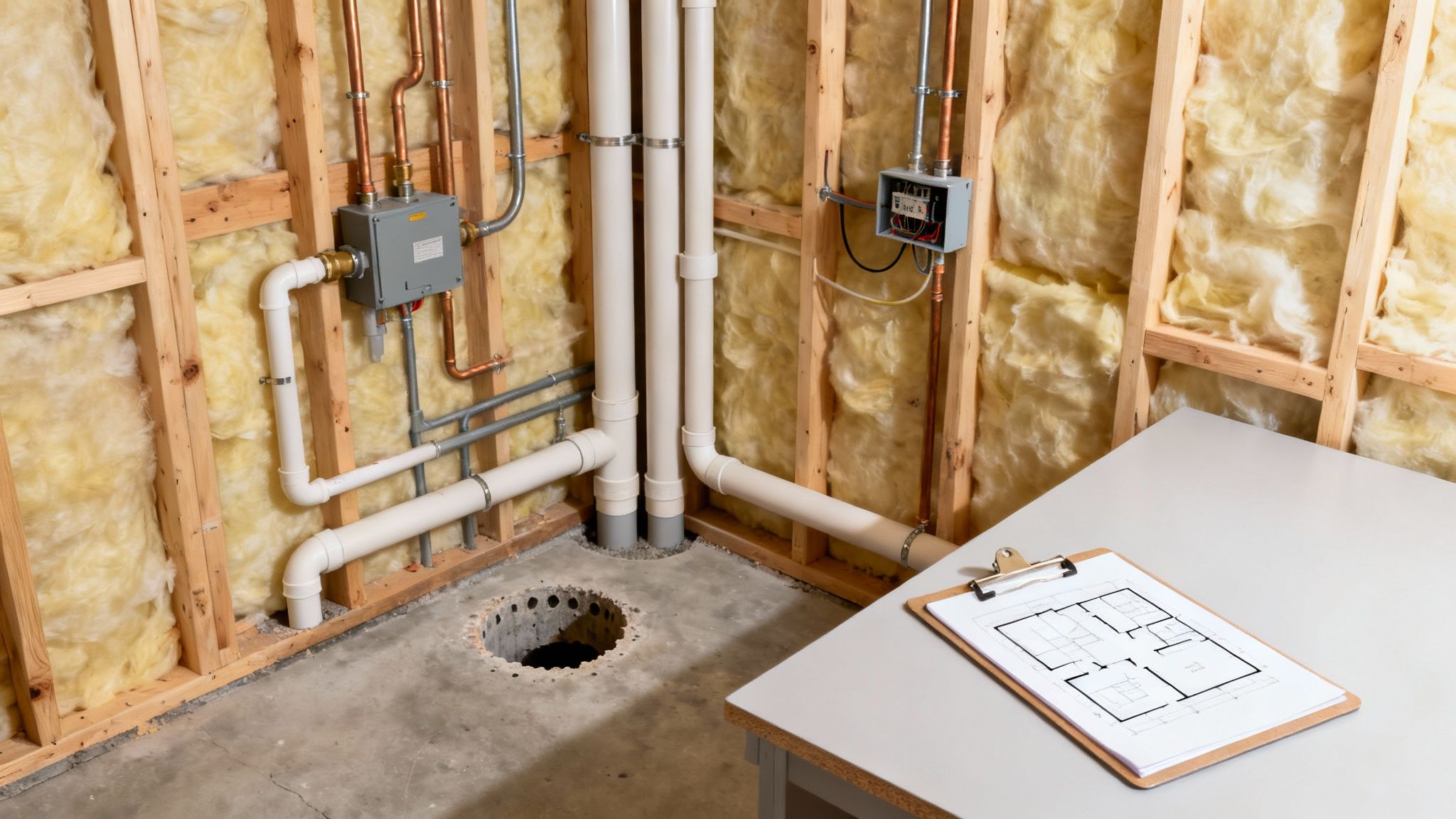
Adding a bathroom to your basement is where things get serious, and it's easily the single biggest cost driver. Unlike an upstairs bathroom where pipes are often right there in the walls, a basement is a whole different ballgame. If your home doesn't already have "rough-in" plumbing stubbed out, we have to build the entire system from the ground up.
This usually involves breaking out the jackhammers. We have to cut into your concrete foundation to lay new drain lines, which is a loud, dusty, and labor-intensive job. It requires absolute precision to make sure everything slopes correctly for proper drainage. Once the pipes are in, we re-pour and finish the concrete.
This one foundational step can run anywhere from $4,000 to $10,000 or more, all depending on the layout and complexity. It's the hidden groundwork that makes the rest of the project possible.
Framing, Insulation, and Drywall: Shaping Your Space
With the underground work complete, we can start building the bones of your new living area. Framing is what transforms a wide-open basement into actual rooms—a bedroom, a family room, and, of course, your new bathroom.
Here’s what you can generally expect for this phase:
- Framing: This covers the lumber and labor to build all the interior walls. For a standard-sized basement, plan for $2,500 to $6,000.
- Insulation: Absolutely crucial for comfort and energy bills in Utah's climate. Good insulation keeps your basement cozy in the winter and cool in the summer, typically running from $1,500 to $3,500.
- Drywall: This is where the space starts to feel real. Hanging, taping, mudding, and texturing creates the finished walls and ceilings. This stage usually costs between $3,000 and $7,000.
These three elements work hand-in-hand to create a space that’s comfortable, quiet, and built to code. Trying to cut corners here can lead to drafts, sky-high energy bills, and poor soundproofing between rooms.
Electrical and HVAC: Powering and Breathing Life into the Space
Today's basements are power-hungry. You need outlets for a home theater, special GFCI circuits for the bathroom, and the right lighting to make the space feel bright and welcoming. An electrician will run all the new wiring, install breaker boxes, and set up your outlets, switches, and light fixtures. This work often falls in the $3,000 to $8,000 range.
Just as important is the air you breathe. You can't just rely on your existing HVAC system to do the job. We have to extend the ductwork properly to guarantee consistent airflow and temperature control. This is what keeps a basement from feeling stuffy or damp and usually costs between $1,500 and $4,000.
Finishes and Fixtures: The Final Touch
This is the fun part—where your personal style shines through and where the budget can really swing one way or the other. Your choices in flooring, paint, tile, and fixtures have a massive impact on the final cost. For a much deeper dive into the specifics of bathrooms, take a look at our detailed bathroom renovation cost breakdown.
Here are some typical ranges for finishes in a basement project:
Flooring: Luxury Vinyl Plank (LVP) is a fantastic, durable choice for basements, costing around $4-$8 per square foot installed. Carpet is another popular option, usually running $3-$6 per square foot.
Paint: A professional paint job that covers all the new walls, trim, and doors will likely be in the $3,000 to $6,000 range.
Bathroom Fixtures: This includes the toilet, vanity, sink, faucet, and shower fixtures. A basic, solid set can start around $1,000, while designer, high-end options can easily top $5,000.
Tile Work: Professional tile installation for the bathroom floor and shower is a must. Depending on the tile you choose and the complexity of the design, this can range from $1,500 to $5,000 or more.
Each of these items plays a role in your total investment. By understanding exactly where your money is going, you can make informed decisions that bring your vision to life without breaking the bank.
What Else Drives Up Your Final Cost?
Beyond the standard line items we've already covered, a few other factors can creep into your budget and really bump up the final number. It’s a lot like planning a vacation—you budget for the flights and hotel, but it's the unplanned dinners out, souvenirs, and last-minute excursions that really add up. Knowing what these "hidden" costs are ahead of time puts you back in the driver's seat.
The two biggest levers you control are your layout and your materials. A simple, wide-open basement floor plan will always be friendlier on your wallet than a complex design with multiple rooms, custom nooks, and angled walls. Every new wall adds costs for framing, drywall, electrical, and finishing.
The same goes for finishes. There's a massive price difference between standard, builder-grade carpet and a basic fiberglass shower insert versus high-end upgrades. If you start choosing heated tile floors, a custom walk-in shower with frameless glass, and a stone-topped double vanity, you could easily double or even triple the cost of the bathroom alone.
Special Features and Code Requirements
Once you get past the basics, the sky's the limit for features that can transform your basement into the ultimate guest suite or entertainment zone. Just remember that these cool additions come with equally cool price tags for the specialized labor and materials they require.
- Wet Bar or Kitchenette: This is a popular one. It means adding cabinets, countertops, a sink, and maybe a mini-fridge or microwave. You can expect this to tack on $5,000 to $15,000+, with the final cost really depending on how much plumbing is needed and the quality of your finishes.
- Home Theater: Want that movie theater experience? A dedicated media room often requires special wiring for surround sound, specific lighting setups, and extra insulation for soundproofing. These elements can add another $3,000 to $10,000 or more to your project.
- Custom Built-Ins: Nothing says "high-end" like custom bookshelves, window seats, or an entertainment center designed just for your space. This is a job for a skilled carpenter, so expect to add a few thousand dollars for their time and materials.
One cost that is absolutely non-negotiable is an egress window. If you're adding a bedroom to your basement, Utah building codes demand a window large enough for someone to escape during a fire. This isn't a simple window install; it involves cutting through your concrete foundation, excavating outside, and installing the window and well correctly. This typically runs from $3,500 to $7,000.
The Surprises Hiding Below Ground
The most frustrating costs are always the ones you didn't see coming. Basements are notorious for hiding problems that only show up after the demolition crew gets to work. Fixing these issues isn't a choice—it's critical for the long-term health and safety of your home.
Even a little bit of moisture has to be dealt with before a single 2x4 goes up. This might mean sealing foundation cracks, re-grading the soil outside your home, or installing a sump pump. Understanding potential water damage repair costs ahead of time can help you prepare for the worst-case scenario.
Here are a few other common surprises we run into:
- Outdated Electrical: If your main electrical panel is already maxed out, it will need to be upgraded to handle the new circuits for your basement.
- Asbestos or Mold: In older homes, we sometimes uncover hazardous materials that require professional, certified remediation before we can safely continue.
- Radon Gas: If tests reveal high levels of radon (a naturally occurring gas), a mitigation system is necessary to keep your indoor air safe.
This is precisely why we always tell our clients to build a contingency fund of 10-15% into their total budget. Having that cushion means a surprise discovery doesn't have to derail your entire project or force you to make compromises you'll regret later.
Visualizing Your Budget: Three Real-World Project Scenarios
Raw numbers on a spreadsheet can feel a bit abstract. So, to bring the cost of finishing a basement with a bathroom to life, let's walk through three realistic scenarios. Each one is based on a standard 1,000-square-foot basement right here in the Orem area, but they all have very different goals, finishes, and, of course, final price tags.
Think of these as financial stories that can help you start writing your own.
Scenario 1: The Essential Guest Suite
The goal here is simple: function and value. This homeowner needs a comfortable, private space for visiting family or friends—a clean bedroom, a small living area, and a durable bathroom. The focus is squarely on maximizing utility without splurging on high-end, decorative finishes.
- Total Estimated Cost: $42,000
- Key Features: We'd keep the layout straightforward to minimize framing and drywall costs. The bathroom would likely have a pre-fabricated shower unit, a basic builder-grade vanity, and standard chrome fixtures. For flooring, durable Luxury Vinyl Plank (LVP) is a fantastic choice, paired with functional and efficient lighting.
- Budget Allocation: The lion's share of the budget goes to the non-negotiables: professional plumbing (which often means cutting concrete), electrical work that's up to code, proper insulation, and a safe egress window. We're prioritizing a rock-solid foundation over fancy frills.
Scenario 2: The Modern Family Hangout
This is the project we see most often. The idea is to create a truly comfortable, multi-purpose space where the family can relax and entertain. It’s designed to feel like a natural extension of the main home, using quality finishes that hit that sweet spot between durability and style.
- Total Estimated Cost: $60,000
- Key Features: This kind of project typically includes a dedicated family room, a guest bedroom, and a full bathroom with more refined touches. Think a nicely tiled shower with a glass door, a semi-custom vanity topped with quartz, and upgraded lighting. Often, we'll add a small dry bar with some cabinetry and a beverage fridge.
- Budget Allocation: Here, a larger part of the budget can shift toward the things you see and touch every day. While the foundational work is still top-tier, more funds are dedicated to higher-quality flooring, more extensive tile work, upgraded baseboards and trim, and a thoughtful lighting plan with recessed cans. This is where a well-planned mid-range budget really shines.
The image below gives a great visual breakdown of how the project scope, material choices, and special features are the main drivers of your final cost.
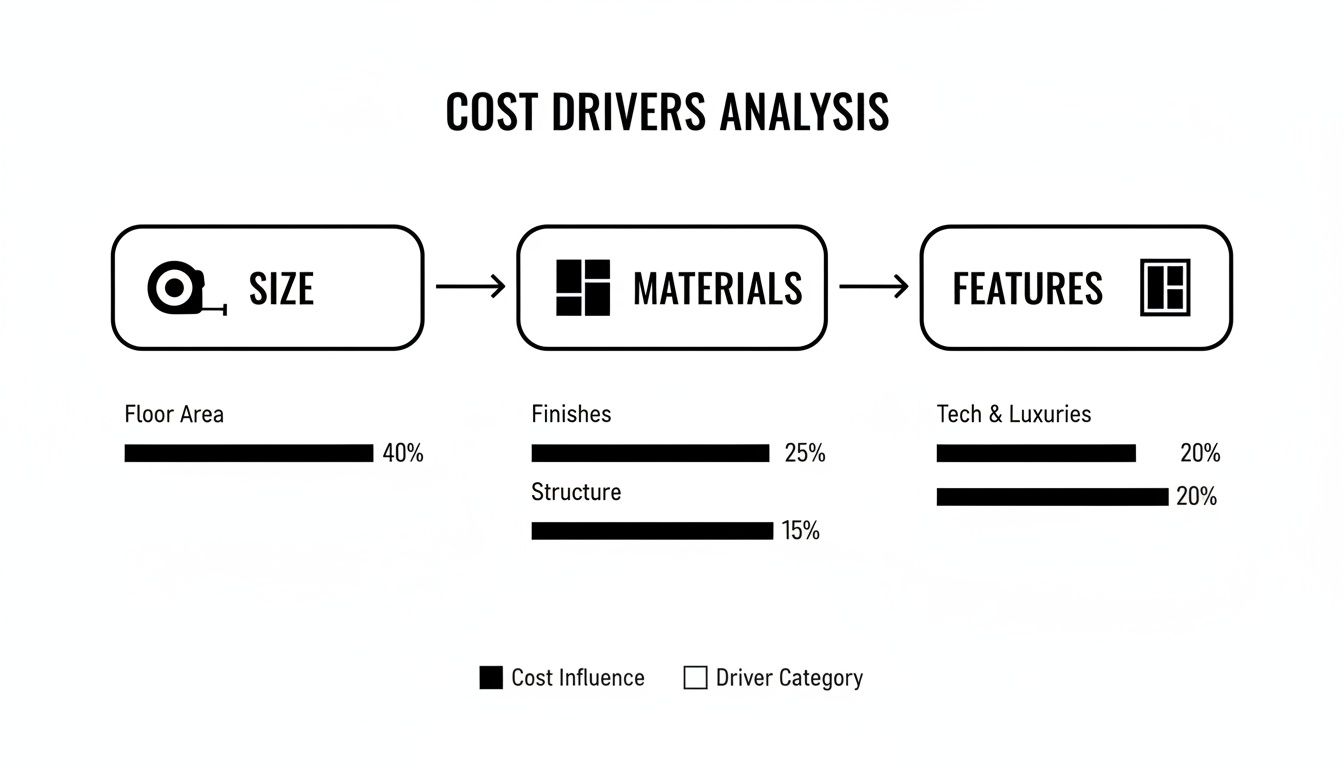
As you can see, every decision about size, materials, and features directly impacts where your money is spent. For an even more detailed breakdown, check out our guide on https://buildnp.com/blogs/how-much-to-finish-a-basement/.
Scenario 3: The Ultimate Entertainment Zone
For this high-end project, the basement isn't just extra space—it's a destination. The goal is pure luxury, comfort, and state-of-the-art entertainment. This is for the homeowner who wants a truly custom, premium space in every detail.
- Total Estimated Cost: $85,000+
- Key Features: This remodel might feature a dedicated home theater with soundproofing and specialized wiring. A full wet bar with custom cabinetry, stone countertops, and high-end appliances is a common request. The bathroom becomes a spa-like retreat with a large, custom-tiled walk-in shower, a double vanity, heated floors, and designer fixtures.
- Budget Allocation: A significant portion of the investment goes toward custom craftsmanship and luxury materials. This means complex plumbing for the wet bar, intricate electrical for the home theater, and the time-intensive labor needed to install premium tile and custom built-ins perfectly.
To see how these priorities play out financially, the table below offers a glimpse into how a budget might be allocated across these three different project tiers.
Sample Project Budget Allocations
| Plumbing & Electrical | 25% | 20% | 15% |
| Framing & Insulation | 20% | 15% | 12% |
| Drywall & Paint | 15% | 12% | 10% |
| Flooring | 10% | 15% | 13% |
| Bathroom Fixtures | 10% | 13% | 15% |
| Lighting & Trim | 8% | 10% | 12% |
| Custom Features | 2% | 5% | 13% |
| Labor & Permits | 10% | 10% | 10% |
This table helps illustrate a key point: as the total budget increases, the percentage spent on foundational work (like plumbing and framing) tends to decrease, while the allocation for finishes and custom features grows.
While these scenarios provide a solid framework, remember that every home is different. The final cost will always depend on your unique space and choices.
A major project like this is a significant investment, so it's smart to look into different financing options that can help make it happen. Nationally, you’ll often hear that mid-range finishes land between $45-$75 per square foot. For smaller basements in Utah that could become a rental unit, a base cost of $6,500-$16,200 can quickly jump to $15,000-$30,000 once you factor in even a half bath, which can add $3,000-$12,000 on its own.
How to Maximize Value and Get the Best ROI
The smartest way to approach a basement remodel is to stop thinking of it as a pure expense. Instead, see it for what it truly is: a powerful investment in your home. Finishing a basement, especially with a bathroom, adds a huge amount of livable square footage. In Utah’s competitive housing market, that's a surefire way to boost your property's value. With the right game plan, you get a space you’ll love to use now and see a fantastic return later on.
The whole point is to spend wisely, putting your budget toward the things that will make the biggest difference in your daily life and your home's long-term worth.
Smart Savings Without Sacrificing Quality
Getting the most bang for your buck doesn't mean you have to cut corners. Real value comes from making smart decisions upfront that save you from costly headaches down the line. It's all about being strategic with your choices to get a high-end result without the eye-watering price tag.
Here are a few proven ways our clients save money smartly:
- Lock in Your Plan: The most expensive phrase in any remodel is "while you're at it..." Deciding to move a wall or add a sink halfway through the project triggers a domino effect of added labor, material costs, and frustrating delays. Finalize every detail of your layout and material selections before the first hammer swings.
- Pick Cost-Effective Lookalikes: You don't always need top-of-the-line materials to achieve a premium look. For instance, high-quality Luxury Vinyl Tile (LVT) can give you the beautiful appearance of hardwood or stone for a fraction of the cost, and its durability is actually better for a below-ground space.
- Cluster Your Plumbing: Whenever possible, we try to design the new bathroom layout to be near your home's existing plumbing lines. The less concrete we have to trench and the shorter the pipe runs, the more you'll save on that intensive plumbing labor.
Invest in the Unseen Fundamentals
It's natural to get excited about picking out tile and paint colors, but trust me on this: the most critical investments you'll make in your basement are the ones you'll never actually see. Spending a bit more on the foundational work isn't just an expense—it's insurance for your entire investment.
Investing in top-notch waterproofing and proper insulation is the single best thing you can do to make sure your basement remodel lasts. It prevents future nightmares from moisture damage and makes your whole home more energy-efficient, saving you real money on utility bills every single month.
Think of it like this: a gorgeous tile floor is completely worthless if you have to tear it all out in five years because of a moisture problem that could have been easily prevented from the start.
Where to Spend for the Best Return
When you're deciding where to allocate your budget to get the best possible ROI, focus on the features that make the space more functional and appealing to the widest audience.
A Well-Designed Bathroom: A clean, stylish, and functional full bathroom is a massive value-add. Time and time again, buyers rank extra bathrooms at the top of their must-have lists.
Flexible Living Space: Instead of boxing everything in, create an open, versatile area. A room that can easily serve as a family room, a playroom, or a home office has much broader appeal to potential buyers down the road.
Good Lighting: Basements have a reputation for being dark and gloomy. A well-thought-out lighting plan—mixing recessed cans, accent lighting, and natural light from an egress window—can make the space feel bright, welcoming, and seamlessly connected to the rest of your home.
At the end of the day, maximizing the ROI on your basement remodel comes from a smart balance of savvy savings and strategic investments. By focusing on a solid plan and quality foundational work, you’ll create a space that makes your life better today and adds real, tangible value to your home for years to come.
Your Pre-Construction Checklist for a Smooth Project
So, you're ready to turn that concrete box downstairs into a genuinely livable, valuable part of your home? Fantastic. But before you get too excited about paint colors and flooring, let's talk about what makes a project go smoothly versus what turns it into a months-long headache. It all comes down to preparation.
Think of it like packing for a big trip. You wouldn’t just toss random clothes in a suitcase and hope for the best. You'd check the weather, confirm your bookings, and make a list. This checklist is your roadmap to starting your remodel with confidence and a clear path forward, ensuring you stay on schedule and on budget from day one.
Laying the Financial and Legal Groundwork
Before we even dream about layouts or picking out tile, we have to get the money and the rules sorted out. Honestly, tackling this stuff first prevents almost all of the major headaches that can pop up later. It ensures your project is financially viable and fully compliant with local Orem, Provo, or Lehi regulations, protecting your investment from the very beginning.
Here’s where you need to start:
- Secure Financing: Get your budget locked in and have the funds accessible. Whether you’re paying with savings, tapping into a home equity line of credit (HELOC), or using a construction loan, have your financing officially in place before you sign any contracts.
- Understand Local Permits: Every city—from Lehi to Provo—has its own set of rules. Spend a little time researching your local building department’s requirements for basement finishes. Pay special attention to anything involving new bathrooms, egress windows for bedrooms, and major electrical work. This isn't just about ticking boxes; it helps you anticipate the necessary inspections and their costs.
Vetting Your Potential Contractor
I can't stress this enough: hiring the right team is the single most important decision you'll make for this entire project. A great contractor is more than just a builder; they’re your partner, your guide, and the person responsible for delivering a high-quality result. Asking the right questions upfront is how you separate the true professionals from the rest.
A great contractor does more than just build. They communicate clearly, manage expectations, and provide transparent pricing. Their answers to your questions should give you peace of mind, not more uncertainty.
Use these questions when you interview potential contractors. Don't be shy about it!
Are you licensed and insured in Utah? Ask to see physical proof of both their general liability insurance and workers' compensation coverage. This is non-negotiable.
Can you provide a list of recent, local references? There is no substitute for talking to past clients about their real-world experience.
Who will be the dedicated project manager for my job? You need to know exactly who your primary point of contact is for daily updates and questions.
How do you handle changes or unexpected issues? Surprises happen. A professional will have a clear process for handling change orders and communicating unforeseen problems.
What is your estimated timeline for a project like mine? It’s an estimate, of course, but an experienced contractor can give you a realistic timeframe.
Will you provide a detailed, itemized contract? A vague contract is a red flag. A clear, detailed agreement protects both you and the builder.
Got Questions? We’ve Got Answers.
Embarking on a basement remodel is a big step, and even the best-laid plans can leave you with a few nagging questions. That’s perfectly normal. We’ve been doing this for a long time, and we've heard them all. Let's tackle some of the most common ones right now so you can feel completely confident moving forward.
How Long Does a Basement Remodel Take?
This is usually the first thing people ask, and for good reason. For a typical 1,000-square-foot basement finish that includes adding a full bathroom, you should realistically plan for a timeline of about 8 to 14 weeks. That's from the day we start demolition to the final walkthrough after the last coat of paint is dry.
Of course, a few things can stretch that timeline out:
- Permits and Inspections: Sometimes, the city's schedule is the biggest wildcard. Waiting for permit approvals or an available inspector can add unexpected days.
- Material Delays: If you've fallen in love with a specific custom tile or a unique vanity, its lead time can dictate part of our schedule. We always plan for this, but it's a factor.
- Project Scope: The more complex the design—think wet bars, custom entertainment centers, or unique layouts—the more time it will take to get every detail just right.
Can We Live in the House During the Remodel?
Yes, absolutely. In almost every project we do, the family continues to live comfortably in the home. A professional contractor knows how to be a guest in your house. We seal off the basement to control dust and debris and maintain a clean path in and out. We're also mindful of our work hours to keep the disruption to a minimum.
Honestly, the loudest and messiest part is usually at the very beginning when we might need to cut concrete for plumbing. That part is over in just a few days.
When you're adding a bathroom to a basement, the two non-negotiables are proper drainage and ventilation. Unlike an upstairs bathroom, basement plumbing often has to fight gravity, which means you'll need specialized equipment—a major driver of the total cost of a basement remodel with a bathroom.
Why Is Basement Plumbing So Complicated?
Basement plumbing is a whole different ballgame. In most homes, the main sewer line exits the house high up on the foundation wall, well above the basement floor. You can’t just rely on gravity to make things flow downhill when "downhill" is below the exit pipe.
That's where an ejector pump (sometimes called a sewage lift pump) comes in. It's a powerful, sealed system that collects all the waste from your new basement bathroom and actively pumps it up to the main sewer line. It’s a rock-solid solution, but the process of cutting concrete, installing the basin and pump, and running the new lines adds a significant layer of work and cost to the project.
Ready to get clear answers for your specific project? The team at Northpoint Construction is here to walk you through every question and provide a transparent, detailed plan for your basement remodel. Let's start the conversation today!