

cost to put in a bathroom in basement: A Complete Guide
So, you're thinking about adding a bathroom to your basement. It's a fantastic way to add function and value to your home, but the first question on everyone's mind is always: "What's this actually going to cost me?"
The short answer is that the average cost to put in a bathroom in basement lands somewhere between $12,000 and $35,000. Of course, a simple half-bath will sit at the lower end of that spectrum. A spa-like full bathroom with high-end finishes and tricky plumbing work? That's when you'll start pushing toward the higher end.
What Is the Real Cost for a Basement Bathroom
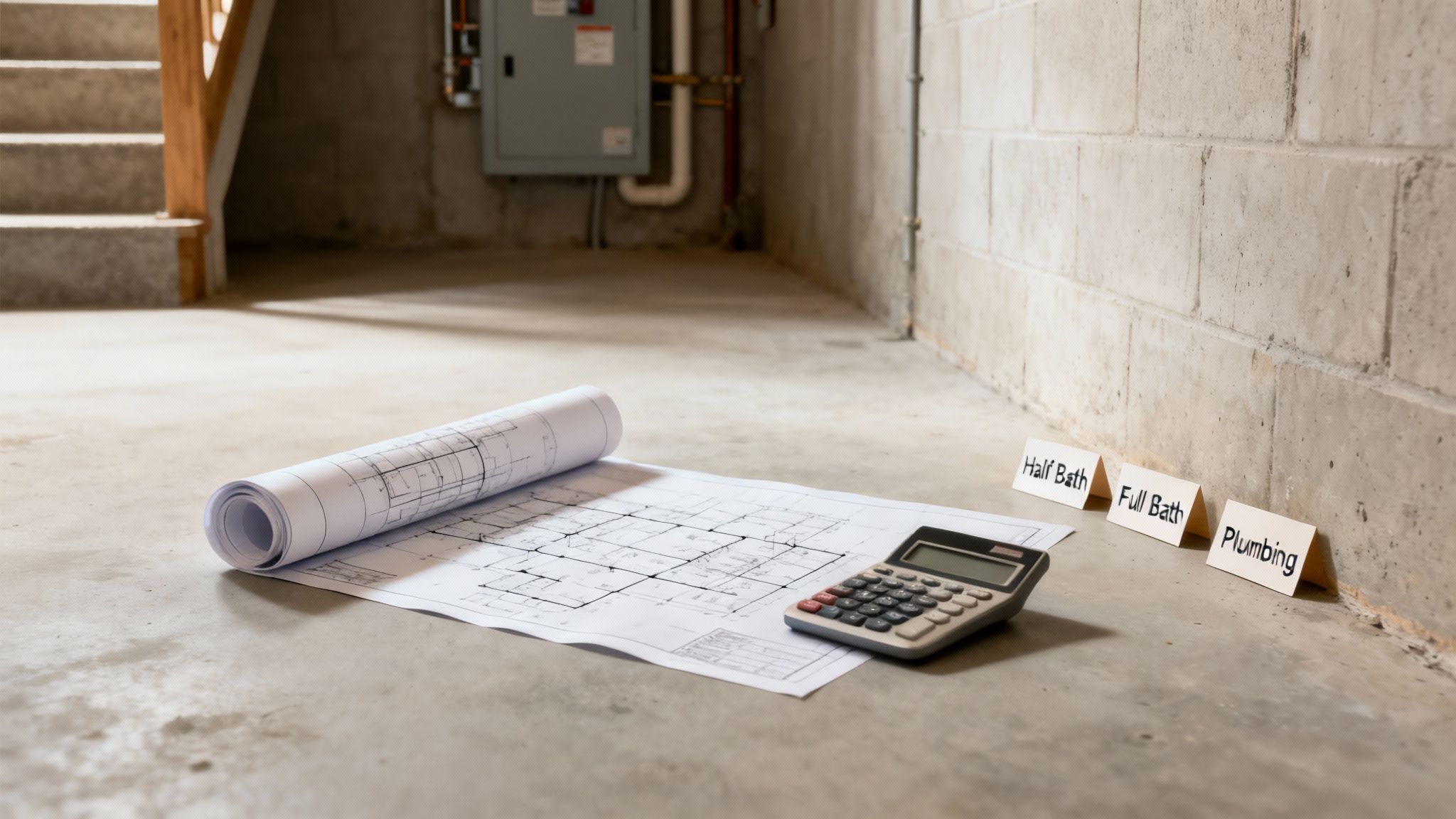
Figuring out the true cost of a basement bathroom is a whole different ballgame compared to a simple upstairs remodel. Think about it: renovating an existing bathroom is mostly about swapping out fixtures and finishes. But building one in the basement means you're starting from scratch—often on a concrete slab, below all your home's existing drain lines.
This underground work, especially the plumbing, introduces unique challenges that really drive the final price.
Your total investment will swing based on a few key factors:
- Plumbing Complexity: This is the big one. Tying into existing sewer lines is a major job that can involve breaking up concrete.
- Bathroom Size: It's simple math—a bigger footprint means more materials, more time, and more labor.
- Fixture and Finish Quality: The difference between a basic off-the-shelf vanity and a custom-built one with a quartz countertop can be thousands of dollars alone.
- Labor Rates: The cost of skilled tradespeople varies quite a bit depending on where you live.
A Starting Point for Your Budget
To give you a better feel for the numbers, let's look at some real-world figures. Based on what we're seeing in the market, adding a full bathroom often tacks on about $25,000 to the overall cost of finishing a basement. That price typically covers the essentials: a shower, vanity, toilet, basic fixtures, and tiled flooring.
For smaller projects, you might budget between $12,695 and $14,845. If you have a bit more space to work with, a medium-sized bathroom generally falls in the $15,920 to $18,070 range. You can find out more details about these renovation figures and what they include.
These are great starting points, but every project is unique. For a budget that truly reflects your home and vision, your best bet is to use a detailed basement finishing cost calculator to get a more personalized estimate.
Estimated Costs by Size and Type
Your first major decision is whether you need a full bathroom with a shower or tub, or if a simple half-bath (just a toilet and sink) will do. This choice has a huge impact on the budget. A half-bath is significantly less expensive because the plumbing is simpler and you're buying fewer fixtures.
A basement bathroom isn't just an expense; it's an investment. A well-designed bathroom can significantly boost your home’s usability and resale value by adding functional living space where there was none before.
To help you start your financial planning, we've put together a quick overview of what you can expect based on the bathroom's size and type.
Estimated Basement Bathroom Installation Costs by Size
| 30-40 (Small) | $8,000 - $15,000 | $12,000 - $20,000 |
| 40-60 (Medium) | $12,000 - $18,000 | $18,000 - $28,000 |
| 60+ (Large) | $15,000 - $22,000 | $25,000 - $35,000+ |
Remember, these figures are a guide. The final cost will always come down to the specific details of your project, from the type of flooring you choose to the complexity of the plumbing required.
Deconstructing Your Basement Bathroom Budget
Trying to figure out the cost to put in a bathroom in the basement is a bit like planning a road trip. You don't just budget for "the trip"; you budget for gas, hotels, food, and activities. Each part has its own cost, and together they make up the total. It's the same with a basement bathroom—breaking it down helps you see where every dollar is really going.
When you understand the individual costs, you can look at a contractor's quote and know exactly what you're paying for. This gives you the power to make smart choices, deciding where to splurge and where you might be able to save a few bucks.
The Foundational Expenses
Before you even think about picking out tile or a fancy vanity, every basement bathroom project has a set of core, behind-the-scenes costs. These are the non-negotiables that make the space functional, safe, and built to last. I always tell my clients to think of this as the chassis and engine of the bathroom—without a solid foundation, the pretty finishes don't matter.
Be prepared for these foundational expenses to eat up a good chunk of your budget, typically somewhere between 40% to 60% of the total project cost.
- Plumbing Rough-In: This is usually the single biggest ticket item. It involves cutting into the concrete to run new drain, water, and vent lines before any walls go up.
- Framing and Drywall: This is where the bathroom takes shape. We build the walls, hang moisture-resistant drywall (a must for basements), and tape and mud it so it’s ready for paint.
- Electrical Work: You'll need a licensed electrician to wire up lights, outlets (which have to be GFCI-protected), switches, and a very important exhaust fan.
- Waterproofing: In a below-ground space, this is crucial. We have to properly seal the concrete floor and walls, and often use special membranes in the shower area to keep moisture out.
Plumbing and Drainage Systems
Plumbing is, without a doubt, the heavy hitter in a basement bathroom budget. It’s a completely different ballgame than remodeling an upstairs bathroom where you can often tap into existing pipes. Down here, you're fighting gravity. That means we either have to break up the concrete slab to install new drain lines or put in special pumps to push waste up to your home's main sewer line.
That kind of work takes a lot of skill and specialized tools, which is why the cost is so high. If you want to see a more itemized list of what goes into a bathroom budget, our guide on a complete bathroom renovation cost breakdown digs into these numbers in more detail.
As a rule of thumb, I tell homeowners to expect basement plumbing to cost double, sometimes even triple, what it would for a similar job upstairs. The labor involved in jackhammering concrete, digging trenches, and then patching it all back up is a massive undertaking.
Electrical and Ventilation Requirements
Good electrical and ventilation aren't just about comfort—they're about safety and meeting building codes. A powerful exhaust fan is absolutely essential in a basement bathroom, which rarely has windows. It’s your number one defense against the moisture that leads to mold, mildew, and that musty basement smell.
Here’s what you can expect your electrical costs to cover:
- Dedicated Circuits: Depending on what you’re installing, the new bathroom will likely need its own dedicated circuit to handle the electrical load.
- GFCI Outlets: Code requires Ground Fault Circuit Interrupter outlets anywhere near water, like by the sink or shower. They’re a critical safety feature.
- Vent Fan Installation: This includes the fan itself plus the labor to run the ductwork all the way to the outside of your house.
- Lighting Fixtures: This is the cost to wire all your lights—from the main overhead fixture to the vanity lights and any can lights in the ceiling or shower.
All told, the electrical work can easily run from $1,000 to $2,500, sometimes more if the wiring runs are long or complex. Trust me on this: spending the money on proper ventilation from day one is one of the smartest investments you can make for the long-term health of your home.
Solving The Below-Ground Plumbing Puzzle
When you add a bathroom on the main or upper floors of your home, things are pretty straightforward. Your plumber ties into existing pipes, and good old gravity takes care of the rest, pulling wastewater down and out.
But in a basement? You're fighting an uphill battle—literally.
The whole game changes because your basement floor is below the home's main sewer line. Gravity is working against you now. Waste and water have to be actively pushed up to get out of the house, which calls for some specialized plumbing. This single, below-grade challenge is the main reason the cost to put in a bathroom in a basement is so much more complex.
Three Paths To Proper Drainage
To get around this gravity problem, you’ve got three main options. Each has its own price tag and level of disruption, so the best choice really depends on your home’s specific layout and your budget.
- Breaking Concrete (The Traditional Way): This is the classic approach. It means bringing in a jackhammer to break up the concrete floor, digging trenches for new drain pipes, and making sure they all slope down toward a central collection point. It’s a messy, labor-intensive job, but it gives you a permanent, gravity-fed system within the basement itself that leads to an ejector pump.
- Sewage Ejector Pump: This system is the engine that makes traditional basement plumbing work. All those new drain lines you installed under the concrete empty into a sealed basin set into the floor. Inside that basin, a powerful pump grinds up waste and forcefully ejects it up to the main sewer line.
- Up-Flush Toilets (Macerating Systems): This is by far the least invasive route. The toilet sits right on top of your existing floor—no concrete breaking required. Waste goes into a small unit behind the toilet that macerates (or grinds) it into a slurry, then pumps it up to the sewer line through a narrow pipe. If busting up your concrete floor isn't an option, understanding Saniflo systems is a great starting point for finding a workable alternative.
This diagram helps visualize how these crucial plumbing decisions are the first step, influencing everything that comes after, from framing to electrical.
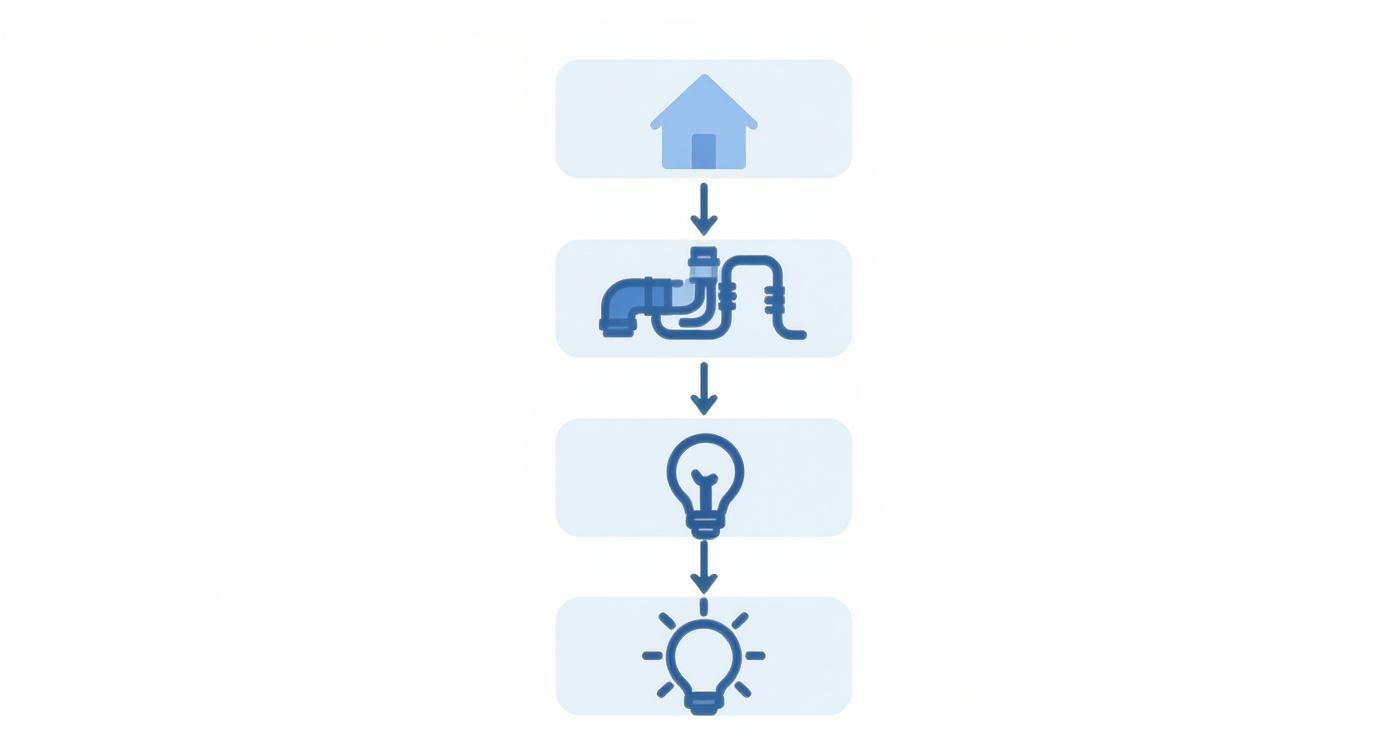
As you can see, the path you choose for your plumbing directly sets the stage for the next phases of the project and their associated costs.
Itemizing The Plumbing Installation Costs
No matter which drainage method you land on, the costs for installing the actual fixtures can add up fast. In many basement remodels, the plumbing and all its related infrastructure can easily eat up nearly half the total budget.
The price for each fixture varies, but you can expect a new toilet installation to run somewhere between $225 and $530. A sink and vanity can cost from $215 to $660. The shower is almost always the biggest-ticket item, starting around $1,100 for a basic stall and climbing to $8,500 or more for a custom tile enclosure.
Plumbing is where the surprises hide. Once you open up that concrete, you never know what you'll find—hidden moisture, unexpected foundation issues, you name it. That’s why we always tell clients to build a 10-15% contingency fund right into their budget.
And don't forget, none of this plumbing will last if it's not in a dry environment. Before a single pipe is laid, you have to be absolutely sure your foundation is solid and dry. Our guide on https://buildnp.com/blogs/how-to-waterproof-basement-walls/ is a great resource for protecting your new bathroom from the ground up.
Typical Plumbing Installation Costs for a Basement Bathroom
To give you a clearer picture, here’s a breakdown of what you can expect to pay for the core plumbing components in a basement bathroom project.
| Sewage Ejector Pump System | $2,000 - $4,500 |
| Up-Flush Toilet System | $1,500 - $3,000 |
| Concrete Breaking & Trenching (per foot) | $100 - $250 |
| Shower/Tub Drain & Water Lines | $1,500 - $3,500 |
| Sink/Vanity Drain & Water Lines | $500 - $1,200 |
| Toilet Installation & Water Line | $300 - $800 |
Ultimately, choosing your plumbing approach comes down to balancing the upfront cost with long-term reliability and how much disruption you're willing to live with. Each method is a proven solution to the below-grade puzzle, capable of transforming a challenging space into a comfortable, functional part of your home.
How Finishes and Fixtures Shape Your Final Cost
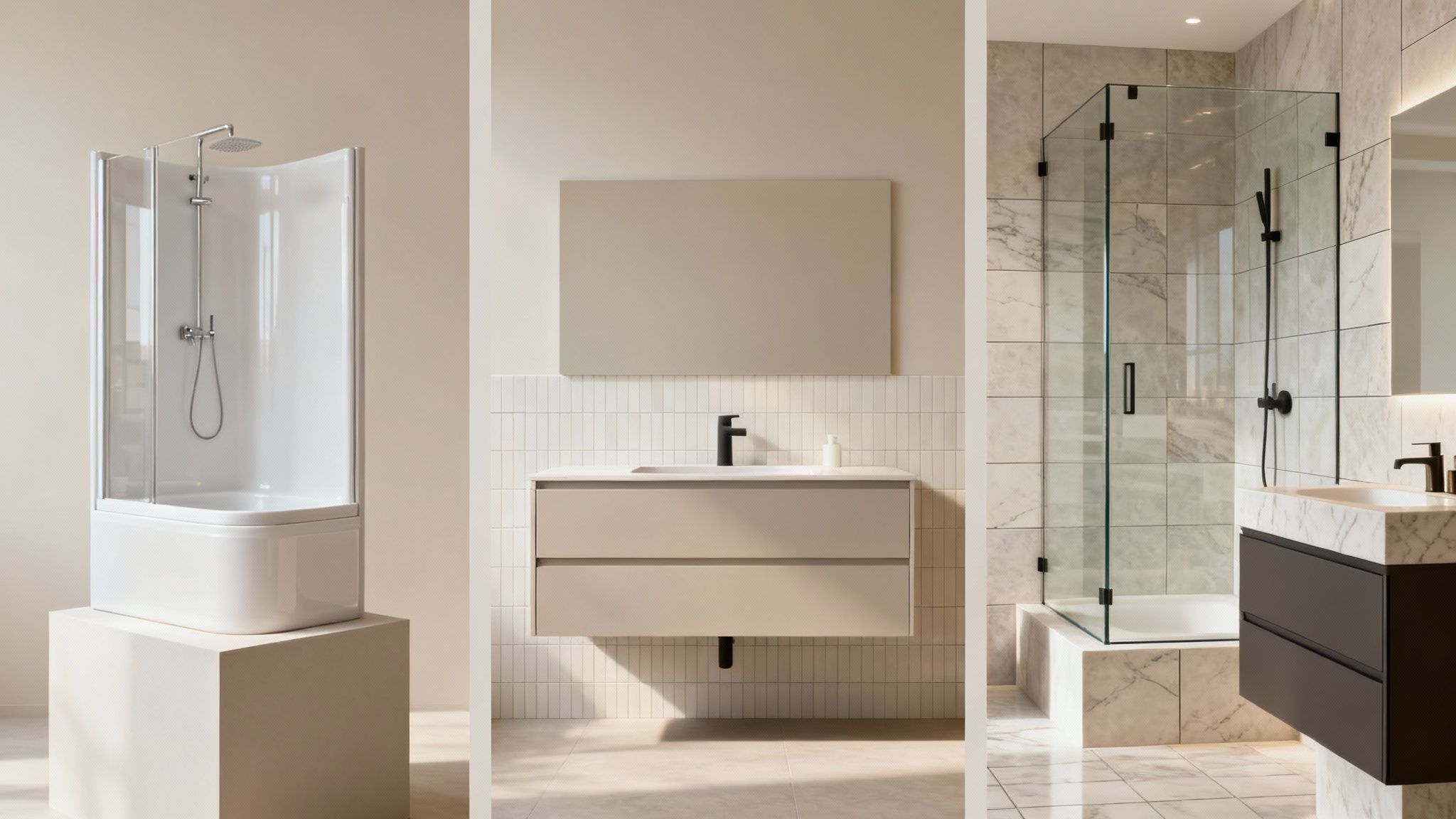
Once the heavy lifting of framing, plumbing, and electrical is done, we get to the fun part: picking out the finishes and fixtures. This is where your new bathroom really starts to show its personality, but it's also where your budget can get away from you if you're not careful. Every choice you make, from the tile under your feet to the faucet on the sink, plays a huge role in the final cost to put in a bathroom in basement.
Think of it like building a car. The rough-in work is the engine and chassis—absolutely essential, but hidden from view. The finishes are the shiny paint job, the comfortable seats, and the high-end sound system. They’re what you see and interact with every day, and they’re a major driver of the final price.
Budget-Friendly Selections
You don't need to break the bank to create a great-looking, functional basement bathroom. By making smart, cost-effective choices, you can get a fantastic result. This approach is all about finding that sweet spot between durability and affordability.
A classic example is the standard one-piece fiberglass shower and tub unit. It’s a workhorse—easy to install, a breeze to clean, and costs somewhere between $500 and $1,500 installed. Pair that with some quality luxury vinyl plank (LVP) flooring, and you’ve got a waterproof, tough surface that looks like wood or tile for a fraction of the cost.
Common budget-friendly options include:
- Flooring: Luxury Vinyl Plank (LVP) or affordable ceramic tile from a big-box store.
- Vanity: A standard, prefabricated vanity that comes with the top included.
- Shower: A one-piece fiberglass or acrylic shower insert.
- Fixtures: Classic chrome faucets and basic, clean-looking lighting.
These choices are practical, widely available, and get the job done beautifully while keeping your project on the more accessible end of the price range.
Mid-Range Upgrades
This is where most homeowners land. The mid-range is all about balancing a more custom, stylish look with a budget that still feels manageable. You get more opportunities for personalization and can invest in higher-quality materials that will last longer and feel more substantial. For materials and fixtures alone, you might be looking at $5,000 to $15,000.
Instead of that all-in-one fiberglass unit, you might go for a fully tiled shower with a sleek glass door. That upgrade alone can add $2,000 to $5,000 to the project, but the visual payoff is enormous. You could also step up to a semi-custom vanity with a stone remnant for the countertop, giving you far more style options than the off-the-shelf models.
The secret to a successful mid-range budget is knowing where to save and where to splurge. It’s smart to invest in the things you touch and see most—like a quality faucet or beautiful vanity lighting—and save on the less glamorous items like the toilet or exhaust fan.
This strategy lets you put your money where it makes the biggest impact, creating a space that feels more luxurious than what the final bill might suggest.
Luxury and High-End Finishes
If you’re dreaming of a true spa-like retreat, the luxury tier is where you’ll find it. This is all about premium materials, custom craftsmanship, and top-of-the-line fixtures. Here, the budget is driven by bespoke work and designer brands, and it’s not unusual for the finishes alone to top $20,000.
A high-end basement bathroom might feature a custom walk-in shower with frameless glass, multiple showerheads, and floor-to-ceiling imported marble. Instead of a standard vanity, picture a custom-built floating cabinet with dual sinks and a thick quartz countertop. Heated floors are another incredibly popular luxury feature, adding that little touch of comfort that makes all the difference on a cold morning.
High-end features often include:
- Custom Tilework: Natural stone like marble or slate, often laid in intricate patterns.
- Premium Fixtures: Faucets and shower systems from designer brands in finishes like matte black or brushed gold.
- Advanced Lighting: A layered lighting plan with dimmers, sconces, and accent lights to create the perfect mood.
- Heated Flooring: Radiant heat installed right under the tile for the ultimate in comfort.
In the end, your choices in finishes and fixtures come down to a mix of your personal taste and your financial plan. By understanding what things cost at each level, you can make informed decisions that bring your vision to life without derailing your budget, ensuring you get a beautiful space you can afford.
Calculating the Return on Your Investment
Thinking about adding a bathroom to your basement? It’s easy to get fixated on the upfront cost, but it’s more than just an expense—it's a smart financial play. Seeing that final bill can be a bit daunting, but you have to look at it as a long-term investment that adds real, tangible value to your home.
This isn't just about the convenience of not having to run upstairs. When it's time to sell, a finished basement with its own bathroom is a massive selling point. It takes a space that most buyers see as a concrete box for storage and turns it into genuinely livable square footage. That’s a distinction that can make or break a sale.
Boosting Your Home's Market Value
A finished basement is nice, but one with a bathroom? That’s a total game-changer. It opens up a world of possibilities for how that space can be used. Suddenly, you have a guest suite, a potential in-law apartment, or a home gym with a proper shower. It becomes a fully functional entertainment zone. This kind of flexibility makes your home stand out to a much broader pool of potential buyers.
A basement bathroom elevates your home from having "extra space" to having an "additional living area." That distinction is huge in real estate because it completely changes how buyers perceive your property's value and utility.
This jump in livability translates directly into a higher resale value. Year after year, home improvement data confirms that bathroom additions are one of the best bangs for your buck when it comes to renovation projects.
Understanding the Financial Payback
The numbers don't lie. The 2025 Cost vs. Value Report shows that a midrange bathroom remodel, on average, recoups about 79.9% of its cost when you sell. That puts it right near the top of the list for financially sound home improvements. Why? Because the market is hungry for homes with modern, functional features, and a well-done basement bathroom fits that bill perfectly. You can check out all the details and explore more remodeling ROI data on CustomCraftDBR.com.
That impressive ROI makes it easier to swallow the initial cost. It’s not just money spent; it's money invested directly into your home’s equity. For a deeper dive into the numbers behind how these projects impact property value, there are some great resources for understanding bathroom remodel return on investment.
At the end of the day, a basement bathroom offers a powerful one-two punch. You get to enjoy the incredible convenience and new functionality for years, all while knowing you’re building equity that you'll get back when you decide to move. It’s an investment that pays you back in your daily life and again at the closing table.
Smart Ways to Save on Your Basement Bathroom Project
Adding a beautiful, functional bathroom to your basement doesn't have to break the bank. With a bit of forward-thinking and some clever planning, you can significantly cut down the cost to put in a bathroom in basement without compromising on the final result. It's all about being smart where it really matters.
Think about it like this: the most expensive and disruptive parts of this project are the ones you'll never see—the plumbing hidden behind the walls and under the concrete floor. By simplifying that foundational work, you can free up a huge chunk of your budget for the things you will see and use every single day, like the vanity, tile, and fixtures.
Get Smart About the Layout
Hands down, the single biggest way to control costs is to be strategic about where the bathroom goes. The closer you can position it to your home's existing main drain and water supply lines, the less you'll spend on both materials and labor.
Every extra foot of pipe, especially the kind that requires jackhammering concrete, adds up fast.
Pro Tip: Placing your new bathroom directly below a bathroom on the main floor, or right next to your home's main sewer line, is the ultimate money-saving move. This decision alone can easily save you thousands of dollars in complex trenching and plumbing work.
This kind of smart placement drastically reduces the amount of concrete that needs to be broken up, which means less mess, less time, and a much lower bill from your contractor. It's the most important first step to a budget-friendly renovation.
Choose Your Materials and Fixtures Wisely
You can get a high-end, polished look for a whole lot less if you know where to look. For example, instead of splurging on expensive natural stone tiles for the floor, check out luxury vinyl plank (LVP). Modern LVP looks incredibly realistic, is 100% waterproof (a must for basements!), and comes in at a fraction of the cost.
Here are a few other savvy swaps that can make a huge difference:
- Vanities: Instead of going the custom route, look for prefabricated vanities that come as a complete package—cabinet, countertop, and sink included. This all-in-one approach is far more affordable than buying each component separately.
- Showers: A custom-tiled shower is a beautiful luxury, but a high-quality acrylic or fiberglass shower insert can save you thousands. They install in a fraction of the time and are incredibly simple to clean and maintain.
- Fixtures: You don't need designer brands to get great style. You can find durable and attractive faucets, lights, and hardware at your local home improvement store. Sticking with a classic chrome finish is often the most cost-effective choice.
Roll Up Your Sleeves (for the Right Jobs)
While you should always leave the critical plumbing and electrical work to licensed pros, a handy homeowner can definitely take on some of the finishing touches to save on labor costs. These simple, low-risk tasks can really chip away at the final invoice.
Consider tackling these projects yourself:
- Painting: A weekend with a paintbrush can easily save you several hundred dollars.
- Installing the vanity and toilet: If you're comfortable with some basic plumbing connections, these are often very manageable installations.
- Putting up trim and baseboards: This is the final piece of the puzzle and a great way to learn a new skill while saving money.
By combining an intelligent layout with cost-conscious materials and a little sweat equity, you can build the basement bathroom you've been dreaming of on a budget that makes you feel just as good.
A Few Final Questions We Often Hear
Even with a solid plan in hand, a few questions always seem to come up right before homeowners are ready to pull the trigger. Here are some of the most common ones we get, along with some straight-to-the-point answers to help you feel confident about your budget.
How Long Does a Basement Bathroom Installation Actually Take?
The honest answer? It really depends. For a relatively simple project where the space is prepped and the plumbing runs are straightforward, you could be looking at 2-3 weeks from start to finish.
But if the project involves a lot of concrete work, intricate tile designs, or waiting on custom-ordered vanities and fixtures, the timeline can easily stretch to 4-6 weeks or more. This is one of the first things you should nail down with your contractor—a clear, written schedule.
Are Up-Flush Toilets a Good Way to Save Money?
They can be, especially on the initial labor bill. The biggest selling point of an up-flush toilet system is that you don't have to jackhammer your concrete floor. That alone sidesteps one of the messiest, most labor-intensive parts of the entire job.
It's a classic trade-off, though. You save a bundle on labor, but the up-flush unit itself costs more than a standard toilet. It also introduces mechanical parts and a pump into the equation, which can mean more potential for maintenance compared to a simple, gravity-powered setup.
Do I Really Need a Permit to Add a Bathroom in the Basement?
In almost every case, yes, absolutely. You're not just hanging a mirror; you're adding complex plumbing, running new electrical lines, and potentially altering the structure of your home. Your local municipality needs to ensure all that work is done safely and meets current building codes.
Think of it less as red tape and more as an insurance policy. A permit ensures the job is done right, protecting your family's safety and your home's value. Any professional contractor worth their salt will insist on pulling the proper permits and will manage that entire process for you. It's non-negotiable for a safe, sound investment.
Ready to turn that unused basement space into a beautiful and functional living area? The team at Northpoint Construction has the expertise to guide you through every step, from initial design and budgeting to a flawless final build. Contact us today to get a detailed estimate for your project!