
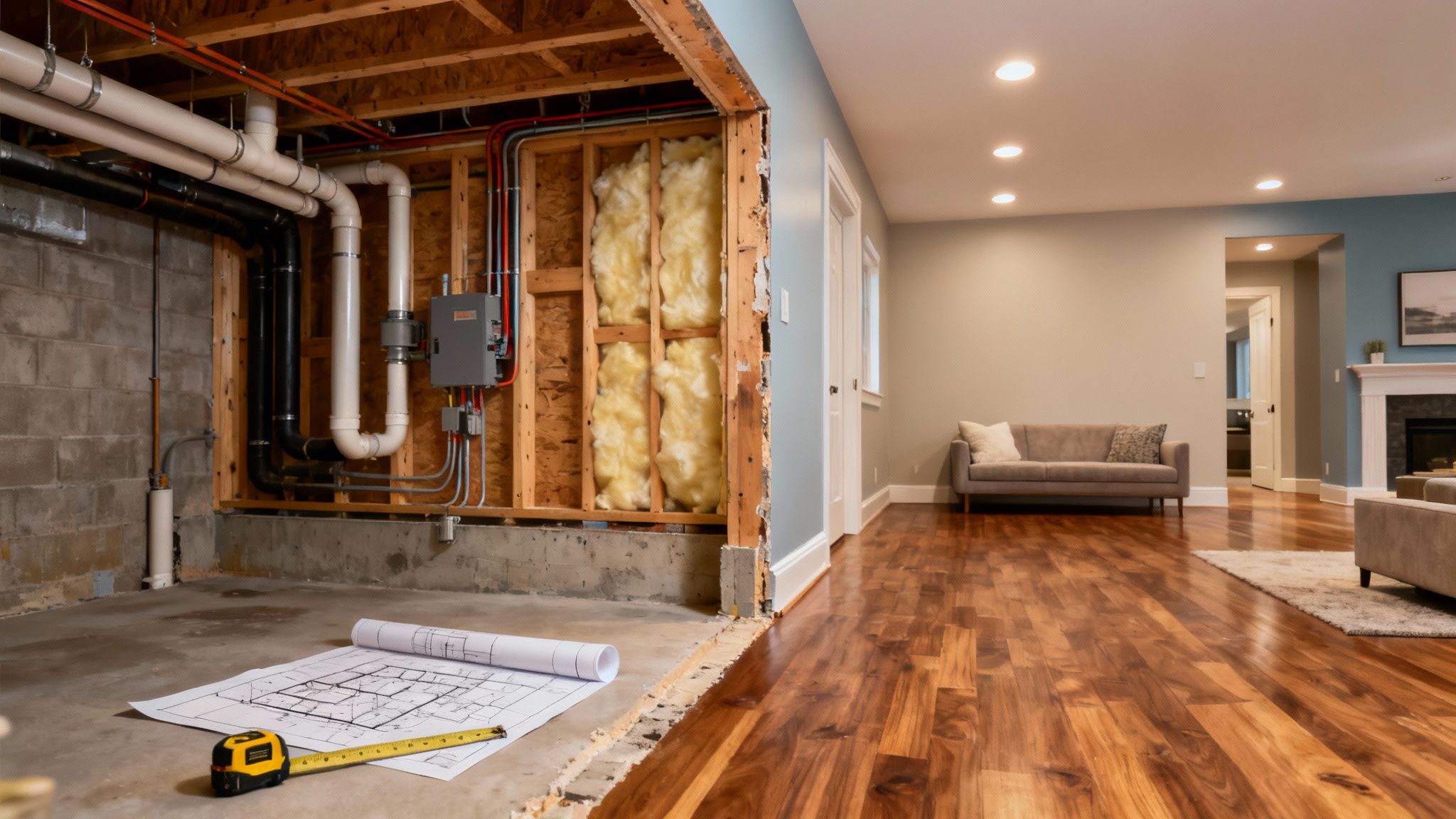
How Much to Finish a Basement in 2024
When people ask me how much it costs to finish a basement, I always say, "Well, that depends." It’s a bit like asking how much a car costs. You can get a reliable daily driver or a high-end luxury vehicle—both get you where you need to go, but the experience and the price tag are worlds apart.
Across the United States, the typical range for finishing a basement lands somewhere between $7 and $23 per square foot. For an average 1,000-square-foot space, this means most homeowners are looking at a total project cost of $7,000 to $23,000. That's a pretty wide range, and it covers all the essentials: materials, labor, and basic, functional finishes.
Your Quick Guide to Basement Finishing Costs
Before we get into the nitty-gritty of line-item costs, let's look at the big picture. Your final budget will hinge on two main things: the size of your basement and, more importantly, the level of quality you choose for your finishes.
Are you picturing a simple, open-concept playroom with durable carpet and standard lighting? Or are you dreaming of a full-blown entertainment space with a custom wet bar, a spa-like bathroom, and recessed smart lighting? The first is your basic, gets-the-job-done model. The second is the fully-loaded luxury edition. Both are great options, but they come with very different price points.
Understanding The National Averages
Looking at the numbers from a national perspective gives us a solid baseline. As we head into 2025, that $7 to $23 per square foot figure holds pretty steady. It’s crucial to remember that labor is a huge chunk of this, often eating up around 40% of the total budget. Don't forget about permits, either—they're a non-negotiable step that can add another $1,200 to $2,000 to the final bill.
The bottom line is this: your choices drive the cost. The single biggest factor that will move your price per square foot up or down is the level of finish you select, from builder-grade basics to fully custom luxury.
A great way to get a ballpark figure is to use a basement finishing cost calculator to plug in your specific numbers. And if you're here in Utah, we've built a detailed local tool for the Orem and Provo area. You can find it right here: https://buildnp.com/blogs/basement-finishing-cost-calculator/
Estimated Basement Finishing Costs by Size and Quality
To give you a clearer idea of how these numbers play out in the real world, here’s a table breaking down potential costs. It shows how the price shifts based on both your basement's footprint and the quality of finishes you choose.
| 800 | $5,600 - $9,600 | $10,400 - $16,000 | $16,800 - $28,000+ |
| 1,000 | $7,000 - $12,000 | $13,000 - $20,000 | $21,000 - $35,000+ |
| 1,200 | $8,400 - $14,400 | $15,600 - $24,000 | $25,200 - $42,000+ |
| 1,500 | $10,500 - $18,000 | $19,500 - $30,000 | $31,500 - $52,500+ |
As you can see, the final investment can vary dramatically. Use these numbers as a starting point to help frame your budget and decide where your project might land on the spectrum from simple and functional to completely custom.
Breaking Down Your Project's Line-Item Costs
Seeing the total price tag for a basement finish can be a bit overwhelming. But when you break it down, line by line, that big number starts to make a lot more sense. Think of it like a grocery receipt—you don’t just see the total, you see the cost of the milk, the bread, and the eggs. Knowing where every dollar is going is the key to creating a realistic budget and making smart decisions.
This breakdown turns one massive expense into a series of smaller, more manageable investments. It helps you see where you can save a few bucks and where it's worth spending a little more for quality. Let's peel back the layers and map out the financial journey of your project.
First, it helps to understand the three main components that make up your total cost.
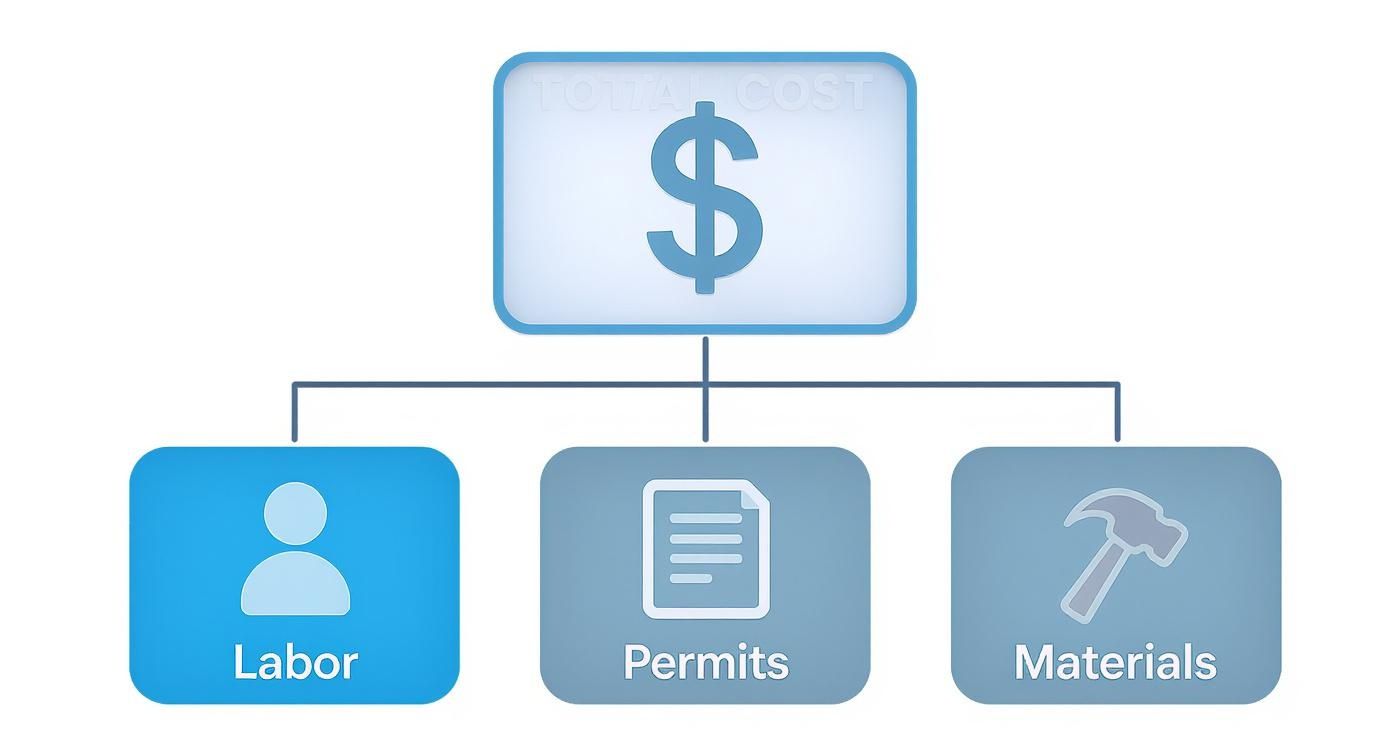
As you can see, the final price is a mix of the hands-on work from skilled tradespeople, the necessary city permits, and the actual materials that will transform your concrete box into a living space.
Framing and Insulation
Framing is what gives your basement its bones. It’s the process of building the interior walls that carve out the new rooms—your future bedroom, home theater, or family room. For a typical 1,000-square-foot space, you can generally expect framing costs to land somewhere between $1,500 and $2,500. This covers both the lumber and the labor to put it all together.
Right after framing comes insulation, which acts as a thermal blanket for your new space. Good insulation is non-negotiable; it not only keeps the basement comfortable but also makes your entire home more energy-efficient. Budget around $1,000 to $2,000 for professional installation, though this can change depending on the type you choose (like fiberglass batts vs. spray foam) and the R-value your local building code requires.
Drywall and Finishing
This is the stage where your basement finally starts to look less like a construction site and more like actual rooms. Hanging, taping, and mudding drywall is a craft. Doing it right results in smooth, flawless walls, while a rushed job can leave you with visible seams and imperfections for years to come.
A great drywall job is the canvas for everything else. Any little flaw—a visible tape line or an uneven patch—will stick out like a sore thumb once the paint goes on and the lights are installed.
The cost for a professional drywall job usually falls between $2 and $4 per square foot of wall and ceiling surface area (not the floor space). For most basements, this works out to a total between $2,000 and $5,000. If you want a deeper dive, check out our guide on the complete cost of drywalling a basement.
Electrical and Lighting
Proper electrical work is what brings your new space to life. It’s more than just a few lights; it’s about strategically placing outlets, planning for future needs, and ensuring everything is safe and up to code. Sometimes this even requires a new subpanel to handle the extra load.
Here's a quick look at what to expect for electrical costs:
- New Outlets: Plan for $100 to $185 per outlet.
- Light Fixtures: A simple fixture install might run $150 to $250, while recessed can lights are often $120 to $300 per light.
- Total Electrical Work: For a full basement, it's wise to budget between $2,500 and $5,000 for a licensed electrician. This is one area where you absolutely don't want to cut corners.
Plumbing and Bathroom Addition
If a bathroom, wet bar, or laundry room is part of the dream, you'll have to account for plumbing. This can be one of the biggest line items, especially if it involves cutting into the concrete floor to run new drain lines. Just the rough-in plumbing for a new bathroom can range from $2,000 to $5,000.
Adding a full three-piece bathroom is a fantastic investment, but it comes at a price. A complete basement bathroom, from pipes to fixtures, can easily add $8,000 to $15,000 (or more) to your overall budget. The final cost really hinges on your taste in fixtures—a basic toilet and vanity will cost far less than a custom-tiled shower with high-end hardware.
Flooring and Final Touches
The floor you choose sets the entire mood of the basement and needs to stand up to the unique challenges of a below-ground environment. Luxury Vinyl Plank (LVP) is a hugely popular choice because it’s waterproof and tough, while carpet remains a go-to for adding warmth and comfort.
Here’s how flooring costs typically shake out, installation included:
- Luxury Vinyl Plank (LVP): Expect to pay $4 to $10 per square foot. For a 1,000 sq ft area, that’s $4,000 to $10,000.
- Carpet: A more wallet-friendly option, carpet usually runs $3 to $7 per square foot, putting the total between $3,000 and $7,000 for the same space.
Finally, you have all the "finishes"—the details that pull everything together. This includes paint, baseboards, trim, interior doors, and any custom touches like built-in shelving. While the costs here can vary wildly based on your choices, it’s a good idea to set aside at least $2,000 to $6,000 to give your basement that polished, truly finished look.
Key Factors That Drive Your Final Basement Cost
Ever wonder why two seemingly identical basement finishing projects end up with wildly different price tags? The answer is always in the details. The road from a concrete shell to a beautiful, livable space is full of choices, and every single one can nudge your budget up or down. Getting a handle on these key factors is the first step to building a realistic budget and avoiding any nasty surprises.
The real starting point for your project's cost is the current condition of your basement. It's almost never a perfect blank slate. More often than not, there are underlying issues you have to tackle before you can even think about framing walls. It's a lot like painting a room—you can't just slap on a fresh coat of paint over cracks and holes and expect it to look good.
If your basement has a history of moisture, that's your first major hurdle. Water mitigation is non-negotiable. This could be as simple as sealing a few foundation cracks, or it might involve a full French drain and sump pump system, which can easily add thousands to the upfront cost. But trust me, ignoring a water problem now will lead to much bigger, more expensive headaches like mold and ruined drywall down the road.
The Impact of Project Scope and Layout
The scope of your project is, without a doubt, the single biggest driver of your final bill. Are you picturing a simple, open-concept family room? Or are you dreaming of a multi-room layout with a couple of bedrooms, a bathroom, and maybe even a kitchenette? Every new wall, doorway, and closet adds to the cost of framing, drywall, and electrical work.
Creating what we call "high-value" spaces also makes a big difference in the budget. These are the features that need specialized trades and more complex work.
- Adding a Bathroom: As we've mentioned, plumbing for a new bathroom can be a major expense. It gets especially pricey if your contractor has to cut into the concrete slab to run new drain lines.
- Creating Legal Bedrooms: For a basement room to legally be called a bedroom, it needs an egress window. Installing one involves cutting a large opening in your foundation. This is a significant structural job that can run anywhere from $3,000 to $7,000, sometimes more.
- Building a Kitchenette or Wet Bar: This introduces more plumbing and electrical lines, not to mention the cost of cabinetry, countertops, and appliances, all of which push the budget higher.
The more complex your layout, the higher your cost. An open floor plan is always the more budget-friendly option because it requires less framing material, fewer doors, and simpler electrical runs than a design with multiple, closed-off rooms.
Material Quality and Finish Selections
This is where your personal taste goes head-to-head with your budget, and the potential for cost swings is massive. Think of it as the difference between buying a generic store brand and a high-end designer label. They both get the job done, but the quality, durability, and price are worlds apart.
Every single finish you choose, from the floor to the ceiling, comes with a spectrum of options. You could go with a budget-friendly carpet or splurge on premium engineered hardwood. You might pick up basic, off-the-shelf light fixtures or invest in a custom smart lighting system. All those little choices add up fast. To get a better feel for how different parts and labor add up, it's helpful to look at other major home projects, like understanding new home system installation costs, as the budgeting principles are similar.
Location and Labor Rates
Finally, where you live plays a huge part in what you'll pay. Labor costs can vary dramatically from one city to the next, and even between different zip codes. Here in the Provo-Orem area, which is a high-demand market, you can expect to pay a bit more for skilled tradespeople like electricians, plumbers, and carpenters than you would in a more rural area.
Nationally, the cost to finish a basement varies widely based on size and the level of finish you're after. For a smaller 500-square-foot basement, you might see a range of $3,500 to $11,500. A much larger 1,500-square-foot project could run from $10,500 up to $34,500. On a square-foot basis, that breaks down to a national average of about $7 to $23, with the higher end reflecting more complex projects with bathrooms and custom features.
Sample Budgets for Common Basement Projects
Numbers on a spreadsheet are one thing, but seeing how they play out in the real world is where it all clicks. To really get a handle on basement finishing costs, let's walk through a few common projects we see all the time. Think of these as financial stories—each with a different size, a unique goal, and a distinct set of choices.
By looking at these examples, you'll see how different priorities, from a simple, durable play area to a full-blown guest suite, directly shape the final price tag. Let's break down three very different basement finishing jobs to see how all those line items we talked about come together.
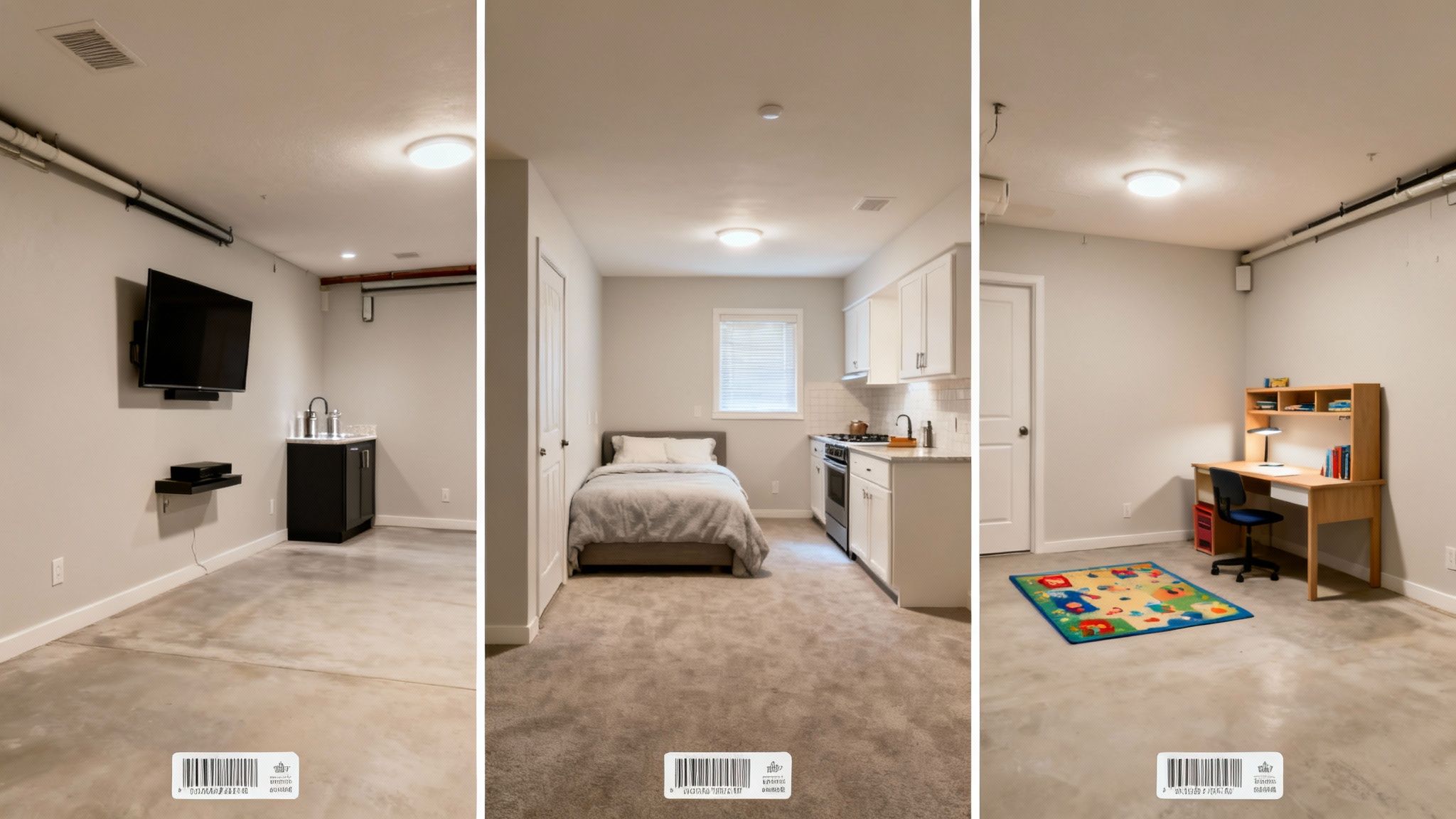
Scenario 1: The Functional Family Space
This is probably the most common request we get. A family has an 800-square-foot unfinished space and needs it to pull double duty as a playroom for the kids and a quiet home office for mom or dad. The goal here is pure function and durability—not high-end luxury.
To keep the budget in check, this project leans into a simple, open-concept layout. This not only makes the space feel bigger but also saves on framing and drywall costs. They're choosing smart, practical materials like tough LVP flooring that can handle anything kids throw at it and standard-grade paint and trim. Crucially, there's no complex plumbing involved, which is a huge cost-saver.
Here’s what a sample budget might look like:
- Permits and Fees: $1,500
- Framing and Insulation: $3,000
- Drywall and Finishing: $4,500
- Electrical (outlets and basic lighting): $3,500
- LVP Flooring: $4,000
- Paint, Doors, and Trim: $2,500
Total Estimated Cost for this Budget-Friendly Finish: $19,000
This is a perfect example of how a straightforward design without major plumbing can add a massive amount of usable space for a very reasonable investment.
Scenario 2: The Ultimate Entertainment Hub
Next up, we have a homeowner whose dream is to create the go-to spot for game nights and family gatherings. They're looking at a 1,200-square-foot basement and envisioning a dedicated media room, a slick wet bar for serving drinks, and a convenient half-bathroom. This project sits comfortably in the mid-range.
Right away, the complexity (and the budget) goes up. Adding a wet bar and a bathroom means significant plumbing and more intricate electrical work. They're also upgrading the materials—think recessed smart lighting to set the mood in the media room, better-quality cabinets for the bar, and soundproofing insulation to keep the movie noise from traveling upstairs.
Here’s a possible cost breakdown:
- Permits and Fees: $2,000
- Framing and Insulation (with soundproofing): $5,500
- Drywall and Finishing: $7,000
- Electrical (recessed lights, dedicated circuits): $6,000
- Plumbing (half-bath and wet bar rough-in): $5,000
- Carpet and LVP Flooring: $7,500
- Finishes (cabinets, countertop, fixtures, paint): $8,000
Total Estimated Cost for this Mid-Range Finish: $41,000
This project really highlights how adding specialized areas with plumbing pushes the final price into a different bracket.
Scenario 3: The Private In-Law Suite
Our final scenario is a premium project designed to add serious function and major home value. The plan is to build out a complete, 1,000-square-foot in-law suite with a legal bedroom, a full three-piece bathroom, and a small, functional kitchenette. This kind of job requires meticulous planning and high-end materials from start to finish.
The single biggest cost driver here is the legal bedroom, which requires an egress window. Cutting into a home's foundation to install one is a major structural undertaking. When you combine that with the plumbing for a full bathroom, the costs for a kitchenette, and premium finishes like quartz countertops and custom tile, you’re looking at a substantial investment.
Let's see how the costs stack up:
- Permits and Fees: $2,500
- Egress Window Installation: $6,500
- Framing and Insulation: $6,000
- Drywall and Finishing: $6,500
- Electrical and HVAC Extension: $7,000
- Full Bathroom Plumbing and Fixtures: $12,000
- Kitchenette (plumbing, cabinets, appliances): $8,500
- Premium Flooring: $8,000
- High-End Finishes (paint, trim, tile): $9,000
Total Estimated Cost for this High-End Finish: $66,000
This shows just how dramatically a project's scope can inflate the budget, especially when structural changes and multiple areas with plumbing and premium materials are involved.
Does Finishing a Basement Actually Pay Off? A Look at the ROI
It’s easy to get laser-focused on the price tag when you're figuring out how much to finish a basement. But that's only half the story. A well-finished basement isn't just an expense; it's a direct investment in your home's equity. You're not just adding a cool new space to live in—you're creating a tangible asset that boosts your property's value down the line.
While it's true that appraisers value below-grade square footage differently than the main floors, it absolutely contributes to your home’s overall market price. More importantly, buyers see a finished basement as a massive win. It’s a ready-to-use family room, guest suite, or home gym without the dust and disruption of a future project. That move-in-ready appeal can make your house stand out, sell faster, and command a better price.
Putting Numbers to Your Potential Return
The financial payback on a basement project is often much better than people expect. Though the exact numbers depend on your local market and the quality of the finish, national data consistently points to a solid return. Most studies show that homeowners recoup around 64% to 70% of what they spend when they sell their home.
So, what does that look like in real dollars? A $20,000 basement renovation could easily add $12,800 to $14,000 back to your home's value. Buyers are willing to pay a premium for that extra living space.
This high return really highlights the importance of doing the job right. A professionally finished basement—one with proper permits, good lighting, and a smart layout—is always going to deliver a stronger return than a slapped-together DIY project.
How to Maximize Your Basement's ROI
Not all finished basements are created equal in the eyes of a potential buyer. If you want to get the biggest bang for your buck, focus on features that add real, practical function.
- Add a Legal Bedroom: This is a big one. By including a bedroom with a proper egress window, you officially increase your home's bedroom count—a major selling point that can push your home into a whole new price bracket.
- Install a Bathroom: A full or even a three-quarter bath makes the basement infinitely more useful. No one wants to hike upstairs every time nature calls. This single feature transforms the space from an "extra room" into a truly livable area.
- Design for Versatility: Think open-concept family rooms or flexible bonus spaces that could serve as a home office, gym, or playroom. The more potential uses a buyer can see, the more valuable the space becomes.
The key to a strong ROI is functionality. A basement that feels like a natural and useful extension of the main home—rather than a disconnected afterthought—will always provide the best return on investment.
At the end of the day, you want to create a space that your family will love using now and that will appeal to a wide range of buyers later. To see how this project stacks up against other upgrades, check out our guide on which home remodels have the best ROI.
Common Questions About Basement Finishing Costs
As you get closer to kicking off your basement project, a few big questions are bound to surface. Getting a handle on the timeline, whether to hire a pro, and the deal with permits can save you a world of hurt later. Let’s tackle some of the most common things we hear from homeowners.
How Long Does It Take to Finish a Basement?
Just like the cost, the timeline for finishing a basement can be all over the map. For a really straightforward, wide-open space with no new plumbing, you could be looking at a 4 to 6-week whirlwind from demo day to the final touch-ups.
But let's be realistic—most projects are more involved. As you start adding features, the calendar pages start turning.
- Adding a Bathroom or Kitchenette: This is a game of Tetris between framers, plumbers, and electricians. That coordination alone can easily tack on 2 to 3 weeks.
- Custom Features: Dreaming of custom built-ins, a fancy coffered ceiling, or intricate tile work? That kind of craftsmanship takes time and patience.
- Permit and Inspection Delays: We're often at the mercy of the city inspector's schedule. Waiting for them to sign off on framing, electrical, and plumbing at key stages is just part of the process.
For a typical basement finish with multiple rooms and a bathroom, a timeline of 8 to 12 weeks is a much safer bet. This gives everyone the breathing room to do their job right and builds in a buffer for those inevitable inspection waits.
Is It Cheaper to Finish a Basement Yourself?
On paper? Absolutely. The idea of saving money by doing it yourself is always tempting. Labor can easily be 40% of the total budget, so on a $30,000 project, you're looking at a potential savings of around $12,000.
But that calculation comes with a huge asterisk. A DIY project that goes sideways can end up costing you far more than just hiring a professional in the first place. Imagine a small mistake in framing or a wiring issue that fails inspection. You'd be forced to rip out brand-new drywall and pay a pro to fix the original problem and repair the damage. Worse, faulty electrical or structural work is a serious safety risk to your family.
The upfront savings of DIY are alluring, but they don't account for the hidden costs of mistakes. The real value of a good contractor isn’t just the labor—it's the expertise, the project management, and the peace of mind that comes from knowing the job is done safely, to code, and built to last.
Do I Need a Permit to Finish My Basement?
Let me make this one easy for you: Yes. Absolutely.
Anytime you're putting up new walls, moving the structure around, or running new electrical and plumbing lines, your city requires a building permit. Here in the Orem and Provo area, getting the city's approval isn't optional; it's a critical part of the process.
Think of the permit as built-in quality control for your project. It ensures every bit of work meets current safety codes, which protects both your family and your home's value. When you eventually decide to sell, a properly permitted basement is a major selling point. Unpermitted work, on the other hand, can spook potential buyers and even blow up a deal at the closing table. It’s a shortcut that’s just not worth taking.
Let's Get Your Project Started with Northpoint Construction
We've covered a lot of ground, from national cost averages to the nitty-gritty details of a basement finishing project right here in Utah. It's a big undertaking, no doubt, but it's also one of the best investments you can make in your home, adding incredible value and much-needed living space.
The secret to a successful project? It all comes down to planning. Before you even pick up the phone to call a contractor, a little prep work goes a long way.
To help you get organized, we've put together a quick checklist. Think of it as the first step in turning those daydreams about a finished basement into a real, actionable plan.
Your Final Basement Planning Checklist
- What's the Big Idea? First things first, what's the main purpose of this new space? Are you dreaming of a cozy family room, a private guest suite for visitors, a quiet home office, or the ultimate entertainment zone?
- What Are Your "Must-Haves"? Make a list of the non-negotiables. Is a full bathroom essential? Do you need a legal bedroom, which means adding an egress window? Maybe a wet bar is at the top of your list.
- What's Your Budget? Looking at the numbers we've discussed, what's a realistic budget range you're comfortable with? Is it closer to $25,000 or are you planning for a more extensive build-out around $35,000 or more?
- When Do You Need It Done? Think about your timeline. Are you hoping to have it ready for the holidays? Do you have family coming to stay for an extended period? Having a target date is incredibly helpful.
- Find Your Vibe: Start collecting photos. Hop on Pinterest, scroll through Instagram, or tear pages out of magazines. Having visual examples is the best way to show a contractor the exact look and feel you're going for.
Once you’ve got these questions answered, you’re ready for the most critical part: choosing the right team to make it all happen.
A great contractor doesn’t just build things. They become your trusted guide, navigating the entire process to make sure your project hits the budget, stays on schedule, and is built to last.
Here in the Orem and Provo area, that's what we do at Northpoint Construction. We’re local, we know the codes, and we’re passionate about turning unfinished basements into beautiful, functional spaces our clients love. We live and breathe this stuff, and our focus is always on transparent communication and quality craftsmanship.
Ready to see what's possible in your home? Let's talk. Reach out to the team at Northpoint Construction for a no-pressure consultation. We'd love to help you build the basement you've always wanted.