
A Complete Kitchen Remodel Cost Breakdown for Utah Homes
When you start thinking about remodeling your kitchen, the first question is always the same: "How much is this going to cost?" The truth is, there’s no single answer.
A complete kitchen remodel cost breakdown shows a huge range. Here in Utah, a simple cosmetic update might run you $15,000, while a full-gut, high-end renovation can easily top $150,000. The final number all comes down to the scope of your project, the quality of materials you choose, and the labor involved. Getting a handle on these key pieces is the first step toward building a budget that actually works for you.
Decoding Your Kitchen Remodel Costs
It's easy to get overwhelmed by the numbers, but your total cost isn't just one big, mysterious figure. It’s really a collection of smaller, more manageable parts. A good starting point is to look at the average cost of a kitchen remodel to get a realistic baseline. For homeowners in our local Orem, Provo, and Lehi communities, having this financial map is the key to a smooth and successful project.
At Northpoint Construction, we believe in total transparency. We walk you through every line item, so you always know exactly where your investment is going. This breakdown is designed to pull back the curtain and show you how a typical kitchen budget is divvied up.
Typical Budget Allocation
To give you a clearer picture, let's look at how the funds for a kitchen remodel are generally distributed. While every project has its own unique fingerprint, most budgets follow a pretty standard percentage breakdown. This helps you see where the biggest expenses will likely pop up before you even start picking out tile.
Here’s a table outlining the typical budget allocation for a kitchen remodel. It shows, on average, what percentage of your total budget goes toward each major category.
Typical Kitchen Remodel Budget Allocation
| Cabinetry | 30% |
| Labor & Installation | 20% |
| Appliances | 15% |
| Countertops | 10% |
| Flooring | 7% |
| Lighting & Electrical | 5% |
| Plumbing | 4% |
| Backsplash | 2% |
| Paint & Finishes | 2% |
| Design & Permits | 3% |
| Contingency | 2% |
As you can see, cabinetry and labor usually take the biggest slice of the pie. Understanding this from the start helps you make smarter decisions about where to spend and where you might be able to save.
A well-structured budget is the most powerful tool in any renovation. It transforms a vague estimate into an actionable plan, giving you control over the final outcome and ensuring your vision aligns with your investment.
From Big Picture to Detailed Plan
Knowing these percentages is a great first step. Now, the real work begins: creating a detailed plan that matches your specific goals and financial reality. This plan becomes your roadmap for the entire project, guiding everything from material selection to contractor schedules.
To get started on creating your own detailed project plan, check out our guide on how to plan your kitchen remodel. A little prep work now is the best way to prevent scope creep and keep surprise costs from derailing your dream kitchen.
A Detailed Line-Item Breakdown: Where Does the Money Go?
When you look at the total cost of a kitchen remodel, that big number can feel a bit abstract. To really get a handle on your budget, we need to break it down, line by line. Think of it less like a single price tag and more like a detailed receipt for a massive project.
Seeing where every dollar is allocated transforms that daunting total into a series of understandable, manageable expenses. This transparency is key. It allows you to make smart decisions about where to spend and where to save, so you can see exactly how each choice you make shapes the final cost.
Every single cost in a remodel falls into one of two major buckets: the skilled labor needed to build it and the physical materials used to create it.
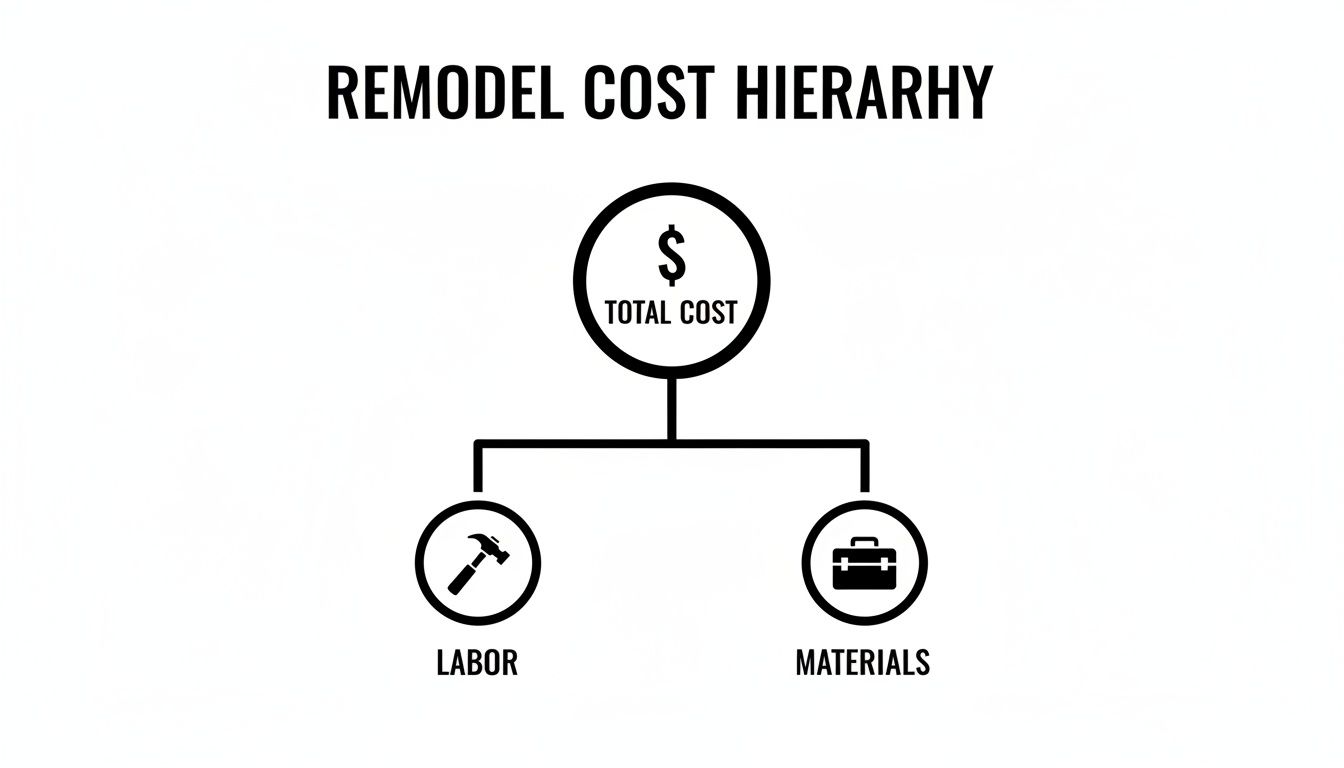
This simple hierarchy is the foundation of any project budget. Now, let's unpack what goes into each side of that equation.
Labor: The Hands That Build Your Dream (20% - 35% of Total Cost)
Labor is the expertise, skill, and sheer hard work that turns a pile of materials into a functional, beautiful kitchen. This portion of the budget, typically 20% to 35% of the total, covers every professional who sets foot on the job site.
Your general contractor is the project's quarterback, coordinating the entire team—plumbers, electricians, painters, and installers. Their management fee ensures the project runs smoothly, stays on schedule, and meets Utah's building codes.
The specialized tradespeople include:
- Plumbers: Needed for everything from moving the sink and dishwasher to running new lines for a pot filler or gas range.
- Electricians: They handle new lighting layouts, wire up your appliances, and add outlets exactly where you need them.
- Carpenters: The pros responsible for the precision work of installing cabinets, trim, and any custom wood features.
- Installers: These are the specialists with the specific skills to flawlessly install countertops, flooring, and tile backsplashes.
Cabinetry: The Backbone of Your Kitchen's Style (30%+ of Total Cost)
Cabinets are almost always the biggest single line item in a kitchen remodel, often eating up 30% or more of your entire budget. They define the room's layout and style, and the choice you make here will have the most significant impact on your final cost.
- Stock Cabinets: The most budget-friendly route. These are mass-produced in standard sizes with a limited menu of styles and finishes.
- Semi-Custom Cabinets: A fantastic middle ground. They start with stock sizes but offer a much wider range of modifications, finishes, and door styles.
- Custom Cabinets: The top-tier option. Built from scratch to your exact specifications, they offer unparalleled quality and complete design freedom but come with the highest price tag.
Countertops: The Hardest-Working Surface (10% of Total Cost)
Your countertops are the workhorse of the kitchen, and they typically account for about 10% of the remodel cost. The price difference between materials is huge, driven by durability, appearance, and how much maintenance they require.
A common dilemma we see is choosing between beauty and practicality. A stunning slab of marble looks incredible, but for a busy family, an engineered quartz often provides a similar high-end look with far greater durability and less stress.
Popular countertop choices include:
- Laminate: The most affordable option, with a surprisingly wide array of modern looks.
- Solid Surface: A mid-range material known for its seamless look and the ability to repair scratches.
- Granite & Quartz: The two most popular choices in Utah. Granite offers unique, natural patterns, while quartz provides bomb-proof durability and consistent coloring.
- Marble & Quartzite: High-end, luxury stones loved for their dramatic veining and timeless appeal, though they generally require more careful maintenance.
Appliances: The Functional Core (15% of Total Cost)
Your appliance suite is the engine of your kitchen, and it usually represents around 15% of your budget. This category has a massive price range, from reliable, standard-issue models to professional-grade appliances that can cost as much as a car. This package includes your refrigerator, range or cooktop, ovens, dishwasher, microwave, and vent hood.
While we're talking about core home systems, this water heater replacement cost guide is a great resource that shows how labor and material factors influence the cost of another essential appliance.
The Finishing Touches: Flooring, Lighting & Fixtures
While they are smaller pieces of the budget pie, these details are what pull the entire design together.
- Flooring (~7%): Costs vary based on the material, from affordable luxury vinyl tile (LVT) to classic hardwood or durable porcelain tile.
- Lighting (~5%): A great lighting plan is layered. This includes recessed cans for general light, pendants over the island for style, and under-cabinet LEDs for task lighting.
- Plumbing Fixtures (~4%): This covers your sink and faucet. A simple undermount stainless sink is a classic, cost-effective choice, while a cast iron apron-front sink with a designer faucet can be a major style statement.
Finally, you have the small but essential items like the backsplash (~2%), paint (~2%), and any necessary city permits (~1-2%). Every single piece, big or small, has its place in the budget.
What Really Drives the Cost of Your Kitchen Remodel?
When you're looking at a quote, it’s easy to get lost in the individual line items. But a few big-picture decisions have a much larger impact on the final price tag than anything else. Understanding these key drivers is the single best way to build a realistic budget and avoid sticker shock down the road.
Think of these as the main control dials for your project. The four big ones are the project's scope, the kitchen's size and layout, the quality of materials you choose, and what's happening in our local market right here in Utah County. A small tweak to one of these dials can send ripples across your entire budget. For instance, deciding to move your sink isn't just a simple plumbing change—it means re-doing cabinetry, cutting new countertops, and patching the floor. Suddenly, a "small" change has a big price tag.
The Scope of Your Vision
By far, the biggest factor determining your cost is what you actually plan to do. Are we talking about a simple refresh, or are we tearing everything down to the studs and starting from scratch? The financial gap between those two scenarios is massive.
- Cosmetic Refresh: This is your most budget-friendly option. We keep the layout as-is and focus on surface updates—things like painting the existing cabinets, putting in new countertops and a backsplash, or upgrading the light fixtures. It’s all about a new look without major surgery.
- Full Renovation (Rip-and-Replace): This is a step up. We’re replacing everything—cabinets, counters, appliances, flooring—but we're keeping the kitchen's original footprint. No walls move, and the plumbing and electrical stay right where they are.
- Gut Renovation with Layout Changes: This is the most involved and expensive route. We strip the room down to the studs and completely reconfigure the space. Moving walls, relocating the sink or dishwasher, and running new electrical for an island all fall into this category. These changes dramatically increase labor costs and require careful planning and permitting.
Kitchen Size and Layout Complexity
It’s a simple truth: a bigger kitchen costs more. It requires more feet of cabinetry, more square feet of countertops and flooring, and more labor hours to put it all together. A 200-square-foot kitchen can easily cost 30-50% more than a 120-square-foot kitchen, even if you use the exact same materials.
But it’s not just about raw square footage—complexity matters, too. Adding an island, for example, isn't just one cost. It’s the cost of the island cabinetry, a separate slab of countertop, and the new electrical work for outlets or pendant lights. Swapping a simple galley layout for a U-shaped kitchen with a peninsula means more complex cabinet installations and countertop cuts, which also drives up the price.
Material and Finish Quality
This is where you have the most direct control over your budget. The difference between standard, builder-grade finishes and high-end, custom materials is enormous, and this applies to every single thing you put in your kitchen.
Think of it like buying a car. You can go with the standard cloth seats (laminate countertops) or upgrade to the premium heated leather package (natural quartzite). Both get the job done, but the feel, the durability, and the cost are in completely different leagues.
Here are a few common trade-offs we see all the time:
- Cabinets: Stock cabinets from a big-box store will always be more affordable than fully custom cabinets built from scratch by a local woodworker.
- Countertops: A durable, modern laminate is just a fraction of the cost of a high-end material like marble or a thick, waterfall-edge slab of engineered quartz.
- Appliances: You can get a solid, standard appliance package for under $5,000. On the other hand, a suite of professional-grade, panel-ready appliances can easily run you over $25,000.
Your Local Market Conditions
Finally, where you live plays a big role. Labor rates, permit fees, and even material delivery costs can vary a lot from one region to another. Here in the Orem, Provo, and Lehi area, we have a strong demand for skilled carpenters, electricians, and plumbers, which naturally influences labor costs.
The demand for remodeling is high, and it’s a trend we’re seeing everywhere. With about 35% of homeowners feeling their kitchens are outdated, the kitchen remodel market is only expected to grow. You can dive deeper into the global kitchen remodel market trends on htfmarketinsights.com to see the bigger picture. This is exactly why working with an experienced local contractor like Northpoint Construction is so valuable—we know the market, the suppliers, and how to get your project done right, right here.
Real-World Utah Kitchen Remodel Budget Scenarios
Numbers and percentages are one thing, but seeing how they play out in a real project is what really brings a plan to life. To give you a better feel for what a kitchen remodel cost breakdown looks like for a home right here in Utah, we’ve put together three scenarios. Each one reflects a common project size and budget level we see every day in neighborhoods from Orem to Provo.
Think of these as starting points. You can see which one feels closest to your own goals and budget, then adjust from there. We'll walk through what’s possible in each tier, from a simple refresh to a full-blown custom renovation, and show you exactly where the money goes.
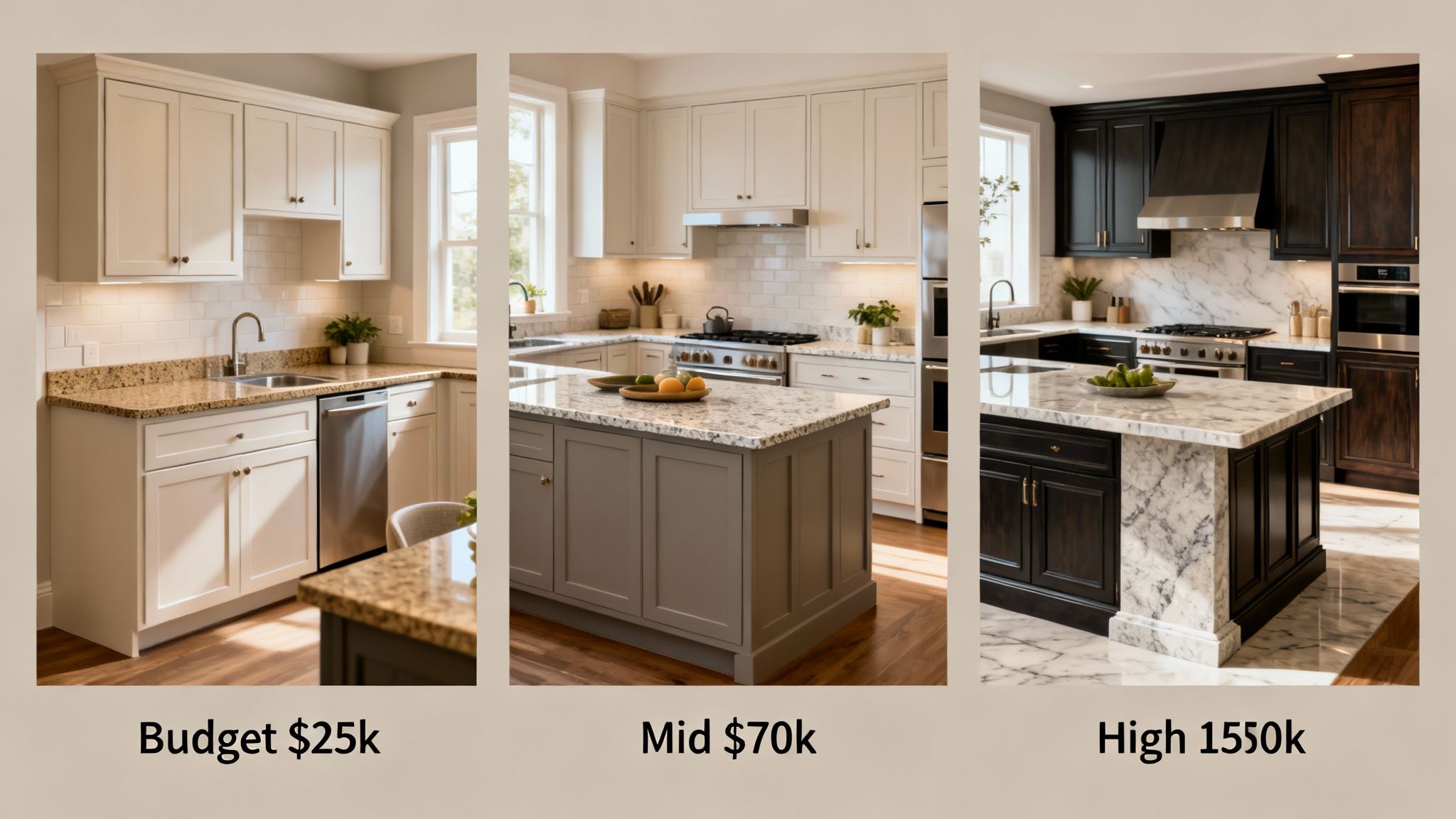
Scenario 1: The Budget-Friendly Refresh ($25,000)
This is the perfect route for a homeowner who wants a major facelift without the cost of tearing everything out. The secret here is working with what you've got—no moving walls, no re-routing pipes or wires. It’s all about making smart, high-impact upgrades.
What We Can Do:
- Keep the kitchen’s current layout and footprint.
- Professionally refinish and paint your existing solid wood cabinets.
- Install new, modern cabinet hardware.
- Swap out old countertops for a high-quality laminate or an entry-level solid surface.
- Add a fresh, simple ceramic tile backsplash.
- Replace the sink and faucet with new, builder-grade models.
- Install a new, standard appliance package.
- Give the walls, ceiling, and trim a fresh coat of paint.
Budget-Friendly Cost Breakdown:
| Labor & Installation | $10,000 | 40% |
| Countertops | $3,000 | 12% |
| Appliances | $4,000 | 16% |
| Cabinet Refinishing | $5,000 | 20% |
| Backsplash & Materials | $1,000 | 4% |
| Sink & Faucet | $500 | 2% |
| Paint & Finishes | $750 | 3% |
| Contingency (2%) | $750 | 3% |
| Total Project Cost | $25,000 | 100% |
Scenario 2: The Mid-Range Remodel ($70,000)
This is our bread and butter at Northpoint Construction—the project we do most often. It’s a full gut-and-replace of all the finishes and fixtures, but we keep the layout the same to keep the budget in check. This price point allows for a serious jump in material quality and a much more personalized feel.
What We Can Do:
- Tear out the old kitchen down to the drywall while keeping the original layout.
- Install new semi-custom cabinets with great features like soft-close drawers.
- Install beautiful and tough-as-nails engineered quartz countertops.
- Add a stylish designer tile backsplash.
- Install a new undermount stainless steel sink and a quality mid-grade faucet.
- Bring in a mid-range appliance package with more bells and whistles.
- Lay new luxury vinyl plank (LVP) flooring throughout the space.
- Upgrade the lighting with new recessed cans and pendant lights over the island.
Mid-Range Cost Breakdown:
| Labor & Installation | $21,000 | 30% |
| Semi-Custom Cabinets | $21,000 | 30% |
| Quartz Countertops | $7,000 | 10% |
| Appliances | $8,400 | 12% |
| Flooring | $4,200 | 6% |
| Lighting & Electrical | $3,500 | 5% |
| Backsplash & Materials | $1,400 | 2% |
| Sink & Faucet | $1,400 | 2% |
| Contingency (3%) | $2,100 | 3% |
| Total Project Cost | $70,000 | 100% |
This mid-range remodel hits the sweet spot between investment and return. It completely changes the way the kitchen looks and works, giving you a space you'll love every day while adding serious value to your home.
Scenario 3: The High-End Custom Renovation ($150,000+)
When you want a kitchen that could be on the cover of a magazine, a high-end remodel gives you total creative freedom. This budget is built for big moves: reconfiguring the layout, taking down walls, and bringing in the absolute best materials and appliances on the market.
What We Can Do:
- Gut the space completely, often removing walls to create an open-concept flow.
- Re-route plumbing and electrical to fit a new, optimized design.
- Install truly custom, handcrafted cabinetry with premium inserts and organizers.
- Install high-end natural stone countertops like quartzite or marble, often with a waterfall island edge.
- Add a stunning, full-height slab backsplash made from the same stone.
- Install a professional-grade appliance suite, including a built-in fridge and a 48" range.
- Lay new hardwood flooring to flow seamlessly with the rest of the house.
- Design a sophisticated new lighting scheme and integrate smart home features.
High-End Cost Breakdown:
| Labor & Installation | $45,000 | 30% |
| Custom Cabinetry | $45,000 | 30% |
| High-End Countertops | $15,000 | 10% |
| Professional Appliances | $22,500 | 15% |
| Structural & Permits | $7,500 | 5% |
| Flooring & Finishes | $6,000 | 4% |
| Lighting & Electrical | $4,500 | 3% |
| Plumbing & Fixtures | $4,500 | 3% |
| Total Project Cost | $150,000 | 100% |
How to Get the Most Out of Your Remodeling Budget
Having a smart budget isn't just about cutting costs; it's about making every dollar work harder for you. When you look at a detailed kitchen remodel cost breakdown, it can feel a little restrictive. But with a few strategic choices, you can stretch your investment and get that high-end look you’ve been dreaming of for your Utah home, all without breaking the bank.
The trick is knowing where to spend and where to save.
If you're looking for the single biggest way to keep your budget in check, here it is: stick with your current layout. Moving plumbing lines for a sink, rerouting gas pipes for a stove, or running new electrical for an island can easily add thousands of dollars to the labor bill. By designing within your kitchen's existing footprint, your money goes directly into the finishes you’ll see and enjoy every single day.
Mix and Match Your Materials
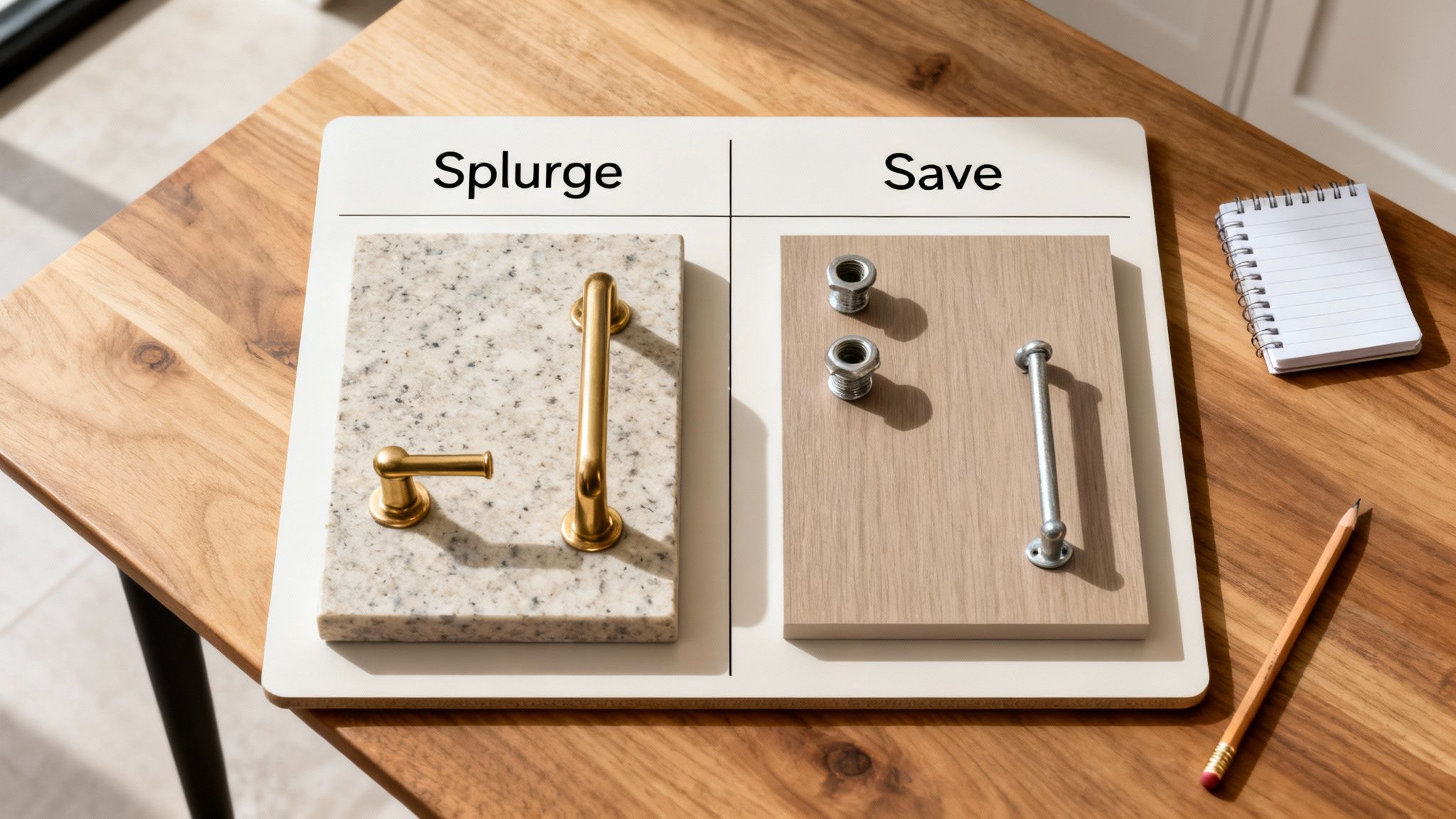
One of the best strategies we use is the "high-low" approach. It's simple: you splurge on the elements that deliver the biggest visual punch and save on the less-critical, supporting details.
- Splurge: Absolutely invest in quality countertops. They're the workhorse of your kitchen and a massive focal point.
- Save: Go for a classic, affordable backsplash. A simple ceramic subway tile, when installed properly, looks just as sharp as pricey marble.
- Splurge: Pick out a fantastic faucet. You'll touch it dozens of times a day, so you want something that feels solid and built to last.
- Save: Shop around for cabinet hardware. You can find stunning pulls and knobs online or at big-box stores for a fraction of the designer price.
This balanced approach channels your funds where they'll have the most impact, creating a kitchen that feels luxurious without the matching price tag.
Smart design isn't about having an unlimited budget; it's about making deliberate choices. A well-chosen, budget-friendly backsplash can make a high-end countertop pop, proving that great style comes from strategy, not just spending.
Reface Your Cabinets Instead of Replacing Them
Are your cabinet boxes still in solid shape? If so, refacing can be a total game-changer. We simply replace the old doors and drawer fronts and apply a new veneer over the existing cabinet frames. You get the look of a brand-new kitchen for a much lower cost—often saving 40% to 50% compared to a full tear-out and replacement.
For more ideas on making a smaller space shine, check out our guide on how to remodel a small kitchen.
Ultimately, the most powerful tool for saving money is meticulous planning. When you finalize every single detail—from the cabinet pulls to the grout color—before demolition starts, you avoid expensive last-minute changes and delays. A rock-solid plan, created with an experienced team like Northpoint Construction, is the best way to ensure your vision and your budget stay aligned from day one.
Calculating the Return on Your Kitchen Investment
A kitchen remodel is one of the most exciting projects you can take on, but it's also a serious financial undertaking. While the immediate payoff is a gorgeous, functional space you'll enjoy every single day, it's smart to think about the long-term numbers, too. That's where Return on Investment (ROI) comes in—it helps you understand how much of your project's cost you might get back when you eventually sell your home.
Think of it like adding premium features to a new car, like a top-of-the-line sound system or custom wheels. Those upgrades make every drive more enjoyable, but you know you won't get every dollar back when you trade it in. A kitchen remodel is much the same; the personal enjoyment is huge, but the direct financial return has its own set of rules.
How Your Project’s Scope Shapes Your ROI
Here's something that surprises a lot of homeowners: when it comes to ROI, bigger isn't always better. While a sprawling, high-end renovation adds incredible personal value, the data consistently shows that smaller, more strategic upgrades often give you a better bang for your buck at resale.
The scope of your remodel is the biggest factor here. Minor remodels that focus on high-impact, lower-cost changes tend to be the most financially efficient path.
A minor kitchen remodel—think refacing cabinets, swapping out countertops, and updating hardware—often has the highest ROI. It dramatically boosts the kitchen's appeal without the massive expense of tearing down walls or rerouting plumbing.
Breaking Down the ROI Numbers
When you dig into remodeling cost and resale value reports, a clear trend emerges. The more you spend on a kitchen, especially on high-end custom features, the lower the percentage of that investment you're likely to see back. On average, homeowners can expect to recover around 59% of what they spend on a kitchen renovation, but this figure swings wildly depending on the project's scale.
To put this in perspective, let’s look at some real-world averages. A minor kitchen remodel with an average cost of around $27,492 can recover a stunning 96.1% of its value. On the other hand, a major upscale remodel averaging over $158,000 typically only sees about a 38% return. You can see more detailed kitchen renovation statistics and their sources at fotileglobal.com to compare the data yourself.
This isn't to say you shouldn't build your dream kitchen! It's simply to clarify that its greatest return will be the personal enjoyment and lifestyle improvement it brings you and your family.
Here’s a quick comparison to illustrate how scope impacts financial returns.
Kitchen Remodel ROI Comparison
| Minor Remodel | $27,492 | $26,420 | 96.1% |
| Mid-Range Remodel | $79,355 | $41,532 | 52.3% |
| Upscale Remodel | $158,074 | $60,099 | 38.0% |
As the table shows, a smaller, more focused project provides the strongest financial return, while larger projects offer more in terms of personal customization and lifestyle upgrades.
Ultimately, the goal is to find the right balance between the kitchen you’ve always wanted and a smart financial strategy. For a deeper dive into how different home improvements compare, check out our complete guide on home remodel return on investment. Understanding these figures empowers you to make an informed decision that enhances both your daily life and your home’s long-term value.
Answering Your Top Questions About Kitchen Remodel Costs
Even with a detailed budget in hand, you're bound to have questions as you start thinking about your project. It's only natural. We hear a lot of the same ones from homeowners in Orem, Provo, and Lehi, so let’s tackle them head-on to give you more confidence.
How Long Does a Typical Kitchen Remodel Take?
The honest answer? It completely depends on what you're doing.
If you’re just doing a cosmetic refresh—think new paint, cabinet hardware, and maybe a new faucet—you could be looking at a quick 1-3 weeks.
For a more standard, full gut remodel where everything comes out but the layout stays the same, plan on 4-8 weeks. But if you're getting into major changes like moving walls, rerouting plumbing, or reconfiguring the entire electrical plan, it’s not unusual for the project to stretch to 10-16 weeks or even longer. That timeline has to account for design approvals, city permits, and the lead times for custom materials, which can really add up.
Do I Need a Permit for My Project in Utah County?
More than likely, yes. Here in Utah County, any work that touches the home's structure, electrical wiring, or plumbing lines will require a permit.
You generally won't need one for simple cosmetic updates like painting your cabinets or swapping out a light fixture. But the minute you start moving things around, the city needs to be involved. A good contractor will handle this entire process for you, making sure everything is up to code and fully compliant. It’s one less thing for you to worry about.
Your contingency fund is your project's financial safety net. It's not a sign of poor planning; it's a mark of smart planning that prepares you for the unexpected issues that can arise in any renovation.
What Is a Contingency Fund?
Think of a contingency fund as your project's emergency savings. It's an extra pot of money—usually 10% to 20% of your total budget—that you set aside specifically for surprises.
And trust me, surprises happen. It could be finding old water damage once the drywall comes down, or maybe you decide halfway through that you just have to have that upgraded appliance. This fund ensures those unexpected costs don’t throw your entire project off track.
Can I Save Money with DIY Work?
You absolutely can, but you have to be smart about it. Taking on tasks like demolition, painting, or even assembling your own IKEA cabinets can shave some real money off your labor costs.
However, some jobs are best left to the pros—no exceptions. Electrical and plumbing work, for example, are not the places to learn on the job. A mistake there isn't just costly to fix; it can be downright dangerous. Any money you think you're saving with a DIY wiring job vanishes the second you have to call in an expert to make it safe and bring it up to code.
Ready to stop wondering and start planning? The team at Northpoint Construction is here to provide a clear, detailed cost breakdown for your dream kitchen. Contact us today for a transparent, no-obligation estimate.