
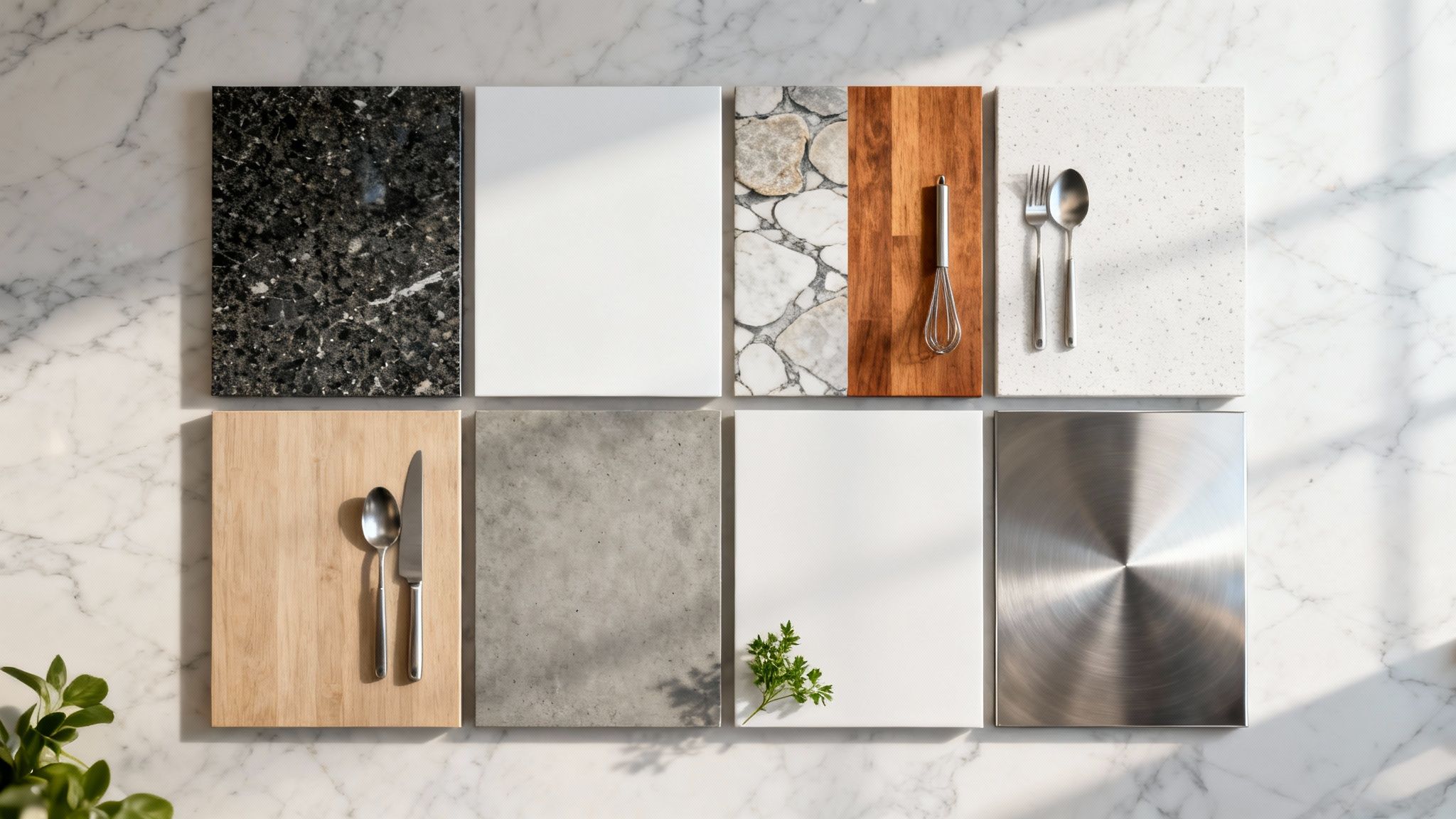
A Complete Kitchen Countertop Material Comparison Guide
When you’re staring down the endless options for kitchen countertops, the choice often boils down to a classic debate: natural stone like granite versus an engineered powerhouse like quartz. Granite slabs bring one-of-a-kind patterns and incredible heat resistance to the table. On the other hand, quartz delivers a bulletproof, non-porous surface with predictable colors and patterns. Your final call really hinges on what you value more—the wild beauty of nature or the practical, low-maintenance appeal of modern engineering.
How to Choose the Right Kitchen Countertop
Picking the perfect kitchen countertop is a huge decision. It's more than just a surface; it's the centerpiece of your kitchen where you’ll prep meals, share stories, and make memories for years. Getting this choice right means finding a balance between looks, lifestyle, and your budget. This guide will walk you through a real-world kitchen countertop material comparison, going beyond basic pros and cons to give you insights you can actually use.
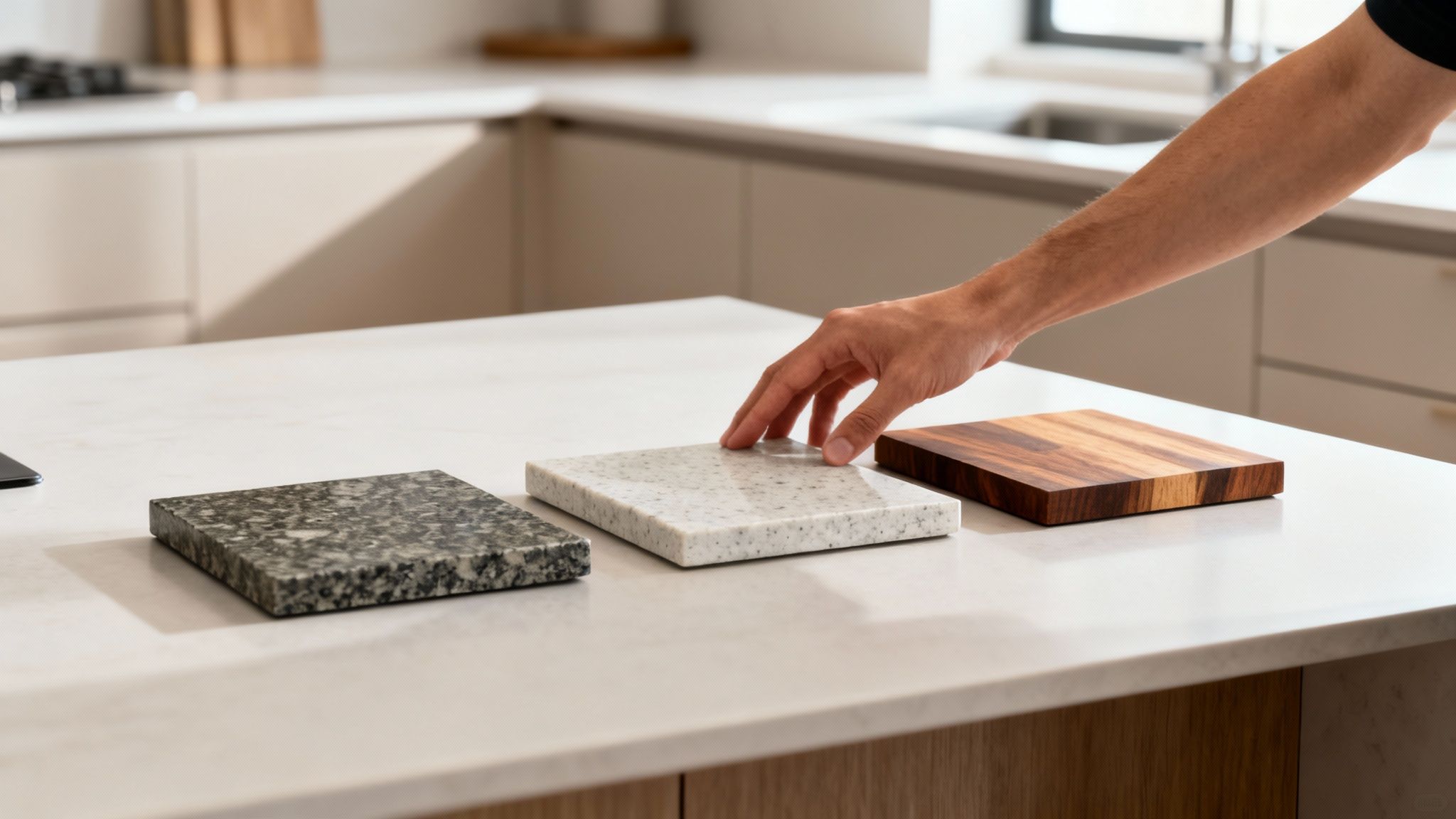
Before you fall in love with a specific material, let's lay the groundwork. Thinking through these key factors is the first and most important step as you plan your kitchen remodel.
- Durability and Lifestyle Fit: Be honest about your daily routine. Will the surface stand up to hot pans, accidental knife slips, and the general chaos of a busy family kitchen?
- Maintenance Requirements: How much time are you willing to spend on upkeep? Some materials need to be sealed regularly, while others are essentially wipe-and-go.
- Resistance to Damage: Think about the common kitchen culprits. How well does the material handle stains from spilled wine or coffee, heat from a sizzling pan, or scratches from a cutting board?
- Overall Value and Budget: It’s not just about the upfront cost. Consider the long-term value and how your choice will impact your home's resale potential down the line.
For years, granite and other natural stones have been the go-to choice. In fact, granite made up over 38% of the global countertop market back in 2022, which shows just how much people love it. But engineered quartz and solid surfaces are catching up fast, winning over homeowners who crave consistency and want to skip the upkeep.
The best countertop isn't just about what looks good—it's about what works for your life. A surface that complements your cooking habits and maintenance tolerance will bring you satisfaction for years to come.
To get started, here’s a quick snapshot comparing some of the most popular materials on the market today.
Initial Countertop Material Snapshot
| Granite | Unique natural patterns | Busy kitchens needing heat resistance. |
| Quartz | Non-porous & low maintenance | Families seeking stain resistance. |
| Marble | Luxurious veining & cool surface | Bakers and high-end aesthetics. |
| Laminate | Budget-friendly & versatile | Cost-conscious renovations. |
Natural Stone Showdown: Granite vs. Marble
When you're looking at natural stone for your kitchen, nothing else offers that one-of-a-kind, straight-from-the-earth beauty. Granite and marble are the two heavyweights in this arena, and each brings a completely different feel to a kitchen. To really choose between them, you have to look beyond their gorgeous surfaces and think about how they'll hold up to your actual, day-to-day life.

Granite is forged under incredible heat and pressure deep inside the earth, a process that makes it exceptionally hard and dense. That intense geological backstory is exactly why it performs like a true workhorse in a busy kitchen.
Marble, on the other hand, is a metamorphic rock that started as limestone. Its composition is softer and more porous, which is what gives it those iconic, luxurious veins—but it also means it’s a bit more delicate than granite.
Durability And Heat Resistance
Granite’s sheer hardness means it stands up incredibly well to scratches and chips. You can slice veggies or slide heavy pots across it without constantly worrying about causing damage. Even better, it's one of the most heat-resistant materials out there; you can set a hot pan down right off the stove without the fear of it blistering or cracking. That makes it a no-brainer for people who cook a lot and need a surface that can take a beating.
Marble is quite a bit softer and will absolutely show scratches and chips from dropped pans or a stray knife. Its real Achilles' heel, though, isn't heat—it's acid. While marble handles warmth just fine, its porous structure makes it extremely vulnerable to common kitchen spills.
The real test is how each stone handles an accident. Spill a glass of red wine on a well-sealed granite counter, and it’s just a simple cleanup. That same spill on marble can leave a permanent stain if you don’t wipe it up that very second.
Maintenance And Stain Prevention
Since both granite and marble are porous, they need to be sealed to fend off stains. How often you have to do this, however, is a huge point of difference and a critical factor in any kitchen countertop material comparison.
- Granite Sealing: A good sealant applied by your installer can protect the stone for a long time. Most granite only needs to be resealed every 1-2 years. A quick water-drop test—seeing if water beads up or soaks in—is an easy way to know when it's time.
- Marble Sealing: Because it’s so much more porous, marble needs a lot more attention. You’ll likely be resealing it every 6-12 months to keep that protective barrier strong.
The biggest maintenance headache with marble is something called etching. This isn't a stain; it's a chemical reaction. When something acidic like lemon juice, vinegar, or even tomato sauce hits the calcium carbonate in the marble, it literally eats away at the surface, leaving a dull, light-colored spot. You can't just wipe an etch mark away. A honed (matte) finish can help hide minor etching, but it’s a reality you have to accept when you live with marble.
Aesthetic And Lifestyle Considerations
In the end, this choice really boils down to your lifestyle. Granite gives you peace of mind. Its rugged durability is perfect for chaotic family kitchens where spills are just part of the daily routine. Its distinct, speckled patterns come in a huge variety of earthy tones that do a fantastic job of hiding crumbs and small imperfections.
Marble, however, delivers a level of timeless elegance and luxury that’s hard to beat. Bakers love its naturally cool surface for rolling out pastry dough, and its soft, sweeping veins create a calm, sophisticated vibe. Choosing marble is about embracing its journey; you have to be okay with the idea that a few etches and marks will become part of its story over the years.
A Tale of Two Engineered Surfaces: Quartz vs. Solid Surface
When you want consistency and predictability that natural stone just can't offer, engineered surfaces are the answer. Two front-runners in this category are quartz and solid surface, but they're built for very different kitchens and lifestyles. Digging into a detailed kitchen countertop material comparison shows that the right choice comes down to what you value more: everyday toughness or long-term repairability.
Quartz is a real powerhouse. It's made by combining around 90-93% crushed natural quartz with polymer resins, creating a surface that’s incredibly hard and non-porous. This means it laughs off scratches and shrugs off stains from coffee, wine, or oil without ever needing a sealant.
Solid surface countertops, on the other hand, are crafted from a blend of acrylic or polyester resins and minerals. This recipe results in a softer, more malleable material. While it might not resist scratches as fiercely as quartz, it has a killer feature: it can be seamlessly fused together, allowing for integrated sinks and completely invisible joints.
Living With Them: Durability Meets Daily Life
The fundamental difference between these two materials reveals itself in how they handle daily use, specifically when it comes to hardness and heat.
Quartz is one of the toughest materials you can put in a kitchen. It’s exceptionally resistant to chipping and scratching, so you don't have to panic if a heavy pot slips from your hand. But there's a catch: the resins that bind it all together can be damaged by high heat. Setting a hot pan directly on the surface is a no-go, as it can cause permanent discoloration or even cracking from thermal shock.
Solid surface is a bit softer, so it will show scratches more easily. The trade-off? Those scratches are usually just on the surface and can be professionally sanded or buffed out, making the countertop look brand new again. This incredible repairability makes solid surface a smart, forgiving choice for busy family kitchens or rental properties where wear and tear is a given. Plus, its seamless construction means there are no crevices to trap grime.
The core difference is simple: repairability versus initial resistance. Quartz is built to resist damage from the start, while solid surface is designed to be easily repaired if damage happens.
Looks and Installation
Both materials come in a huge array of colors and patterns, but they create a completely different vibe. Quartz is a master of mimicry, beautifully replicating the look of high-end marble or granite with all its complex veining—but without the upkeep. It also comes in a wide range of bold, solid colors perfect for a sleek, contemporary kitchen.
Solid surface offers a softer, more uniform appearance. Its real magic lies in its flexibility. It can be molded and shaped to create integrated sinks, coved backsplashes, and impossibly long, seamless runs. The result is a smooth, monolithic look that quartz, with its visible seams between slabs, simply can't match.
The market is clearly favoring these predictable, high-performance materials over their natural counterparts. Engineered quartz is a standout, boasting a 7.60% compound annual growth rate in the global countertop market—a pace that's leaving materials like granite in the dust. It's clear that homeowners are voting for the reliable performance and design control that engineered surfaces provide. You can dig deeper into these countertop growth insights to see just how much consumer tastes are shifting.
A Closer Look at Smart, Budget-Friendly Countertops
You don’t always need a premium price tag to create a kitchen with serious wow factor. While materials like granite and quartz get a lot of attention, there are some fantastic, budget-friendly alternatives that deliver big on both style and performance. Let's dig into a few of my favorites: laminate, butcher block, and concrete. Each one brings something unique to the table for homeowners trying to make every dollar count.
Today’s high-definition laminate is a complete game-changer and a far cry from what you might remember from decades past. Thanks to incredible advancements in printing technology, it can convincingly replicate the look of high-end granite, marble, or even richly grained wood—all for a fraction of the cost. This makes it a go-to choice for smart remodels or for updating a rental property where you need durability and style without a huge investment.
If you're working with a smaller footprint, pairing cost-effective materials with a smart layout is the key to success. You can find some great ideas on how to remodel a small kitchen that really make the most of every square inch and every dollar in your budget.
The Warmth of Butcher Block
There's an undeniable warmth that butcher block brings into a kitchen. It instantly creates an inviting, almost rustic atmosphere that’s hard to replicate. Made by fusing together pieces of wood, it provides a softer, more forgiving surface that’s noticeably gentler on your dishes and glassware if you accidentally knock one over. Plus, you can technically prepare food right on it, though this will absolutely lead to scratches and wear.
That beautiful, natural appeal does come with a bit of a trade-off: maintenance.
- Regular Oiling is a Must: To keep the wood from drying out, cracking, or soaking up stains, you have to treat it regularly with a food-safe mineral oil. This simple step creates a protective barrier that maintains its rich, healthy look.
- Water is Not Its Friend: You have to be vigilant about standing water. Spills need to be wiped up right away to prevent dark water stains and potential warping, especially around the sink.
Despite the upkeep, one of butcher block's best features is its renewability. Scratches and minor stains can simply be sanded out and the surface refinished, giving it a longevity that many other materials can't match.
Butcher block is a living surface. It evolves with your kitchen, gaining a unique patina and character over time that tells the story of the meals prepared on it.
The Industrial Appeal of Concrete
If you’re aiming for a bold, modern, or industrial vibe, concrete countertops make a powerful statement. They are poured and customized to your exact needs, which means you can dial in specific colors, textures, and even embed cool things like recycled glass for a truly one-of-a-kind look. That level of personalization is something you just don’t get with most other materials.
Of course, concrete's custom nature means you have to know what you’re getting into. It's a naturally porous material, making it very susceptible to stains and etching from everyday acidic things like lemon juice, vinegar, or wine.
Proper sealing is absolutely non-negotiable to protect the surface, and you’ll need to reapply that sealant periodically to keep it in top shape. Concrete is also incredibly heavy, so it requires professional installation to make sure your cabinets can handle the load. While it’s tough as nails against heat and scratches, you have to be prepared for the possibility of hairline cracks developing over time. It’s all part of its industrial charm, making it a better fit for someone who appreciates a rugged, evolving surface over a flawless, pristine one.
A Practical Guide to Choosing Your Countertop
Trying to weigh all the pros and cons of different countertop materials can make your head spin. To simplify things, I've put together a decision matrix that cuts straight to the chase, scoring the most popular options based on what really matters in a busy kitchen.
Think of this as your cheat sheet. It lets you quickly compare how materials like Granite, Quartz, and Marble perform side-by-side. Whether your top priority is an iron-clad budget or a surface that can take a beating with minimal upkeep, this will help you see which options rise to the top. Remember, countertops are just one piece of the puzzle; understanding where this expense fits into the overall project is key. For a wider view, check out this detailed look at a full kitchen remodel cost breakdown.
Kitchen Countertop Material Comparison Matrix
Here's a straightforward look at how the top countertop contenders stack up against each other. I've rated each one on a simple 1-to-5 scale, where 5 represents the best possible performance for that category. This makes it easy to spot the leaders and laggards at a glance.
| Granite | $45 - $200+ | 5 | 5 | 4 | Moderate |
| Quartz | $55 - $150+ | 5 | 3 | 5 | Very Low |
| Marble | $60 - $250+ | 2 | 4 | 2 | High |
| Solid Surface | $50 - $120 | 3 | 2 | 4 | Low |
| Laminate | $20 - $60 | 2 | 2 | 3 | Very Low |
| Butcher Block | $40 - $150 | 3 | 1 | 2 | High |
This kind of evaluation process isn't just for kitchens. You'll find similar trade-offs when comparing different home surface materials like flooring, where you're always balancing style, cost, and practicality.
My Pro Tip: The fastest way to narrow your options is to pick your top two priorities. Are you all about budget and easy care? The matrix instantly directs you to Laminate or Solid Surface and lets you filter out pricier, high-maintenance choices.
Sometimes a visual path is the easiest way to figure things out. This flowchart guides you through the decision based on what you value most—price, style, or your willingness to DIY.

As you can see, your budget is almost always the first major filter. It's the most powerful factor in shaping your list of realistic countertop contenders from the very beginning.
Finding the Right Countertop for Your Life
Let's be honest, there's no single "best" countertop. The perfect choice for your kitchen really comes down to you—how you live, how you cook, and what you want from your home. A great countertop isn't about picking the most popular material; it's about finding the one that fits your reality.
I'm going to walk you through my top recommendations for three very different situations: the chaotic family kitchen, the serious home chef's workspace, and the practical rental property. These are insights I've gathered over years of seeing what works and what doesn't in the real world.
For the Busy Family Home
The family kitchen is the command center of the house. It's where juice gets spilled, art projects get messy, and homework gets done. You need a surface that can take a beating and clean up easily. For this, quartz is pretty much unbeatable.
Because it's non-porous, you never have to worry about sealing it. Spills from grape juice, coffee, or even a rogue marker won't sink in and become a permanent problem. A quick wipe with soap and water is all it takes, which is a lifesaver for parents with no time to spare. Plus, it's incredibly hard, so it can handle dropped dishes, dragged toys, and the general wear-and-tear of daily life far better than softer options like butcher block.
When you're managing a busy family, you want your kitchen to be predictable. Quartz gives you a worry-free surface that lets you focus on your life, not on policing every little spill.
Another fantastic choice for family life is solid surface. It isn't quite as tough against scratches as quartz, but its superpower is that it's renewable. If you do get a deep scratch or a stubborn stain, a professional can often sand it right out, making the countertop look brand new again. That's an incredibly forgiving feature for a chaotic home.
For the Gourmet Home Chef
If your kitchen is more of a workshop than a showroom, you need countertops that work as hard as you do. A serious cook needs a surface that can handle searing heat, stand up to heavy-duty prep, and support all kinds of culinary projects.
Often, the best setup is a mix of materials. I love using granite around the stove. It's naturally heat-resistant like nothing else, so you can pull a hot pan right off the burner and set it down without scrambling for a trivet. That kind of seamless workflow is a huge deal when you're in the middle of a complex recipe.
Then, for a dedicated baking station, you can't beat classic marble. Its surface stays naturally cool, which is exactly what you want for working with pastry dough—it keeps the butter from melting and makes rolling out pie crusts a breeze. Yes, it's prone to etching from acids like lemon juice, but if you keep it to one specific prep zone, the risk is much easier to manage.
For the Rental Property or Budget Renovation
For a rental property or a quick home flip, your priorities shift. You're looking for the best bang for your buck, a durable surface, and something that will appeal to most tenants. The countertop has to look great but also be tough enough to handle renters who might not be as careful as a homeowner.
High-definition laminate is a brilliant choice here. The technology has come a long way, and modern laminate offers incredibly realistic stone and wood patterns for a fraction of the cost, usually running $20 - $60 per square foot installed. It lets you give the kitchen a fresh, modern feel without sinking a ton of cash into it. Best of all, it's a breeze to clean and requires zero special care from tenants.
Solid surface is another smart investment for rentals. While it costs more upfront than laminate, its secret weapon is repairability. Minor dings and scratches can be buffed out, which means you can refresh the countertop between tenants instead of replacing it entirely. Over the long haul, that can save you a lot of money and keep the unit looking its best for years.
Common Questions About Kitchen Countertops
Even after digging through all the comparisons, a few specific questions always seem to pop up. Answering these is the final hurdle before you can confidently pick a countertop you'll love for years. Let's get into some of the most common things homeowners ask.
Which Countertop Material Offers the Best Resale Value?
When you’re thinking about your home’s future value, two materials consistently give you the best bang for your buck: granite and quartz. Granite has been a go-to for decades; its natural, one-of-a-kind patterns feel timeless and scream quality to potential buyers.
Quartz, on the other hand, gives you that modern, high-end look without the fuss. For today's busy families, a low-maintenance countertop is a massive selling point. While something like marble can look incredible in a luxury home, its reputation for being high-maintenance can actually scare some buyers away.
Pro Tip: If maximizing ROI is your main goal, you can't go wrong with a neutral-colored granite or quartz. It's a safe bet that will appeal to the widest range of people, whereas a bold, personal choice might not.
Can I Place a Hot Pot Directly on My Countertop?
This is a big one, and the answer is a firm "it depends." Granite was formed by intense heat and pressure, so it can generally handle a hot pan straight from the stove for a few moments without any issue.
That said, you should absolutely not try this with most other materials.
- Quartz: The resins that bind the stone together can be damaged by sudden, extreme heat—a phenomenon called thermal shock. This can lead to cracks or ugly discoloration.
- Marble, Solid Surface, and Laminate: These are all susceptible to scorching, burning, or permanent stains if a hot pan touches them.
- Butcher Block: As a natural wood, it will definitely scorch if you place a hot pot directly on it.
Honestly, the best practice is to just always use a trivet or hot pad. It's such a simple habit, and it's the easiest way to protect your investment, no matter what countertop you have.
Should I Choose a Polished or Honed Finish?
Your choice of finish really comes down to the look you want and how much daily upkeep you're willing to do. A polished finish gives you that classic, shiny look that makes the stone's colors and patterns pop. It’s also a bit less porous than other finishes, which gives it a slight edge in stain resistance.
A honed finish has a soft, matte appearance that feels very modern and does a fantastic job of hiding minor scratches. The trade-off is that the surface is a little more open, making it more likely to show fingerprints or absorb spills. For marble, though, a honed finish is great because it makes etching from things like lemon juice or wine much less obvious.
And while we're on the topic of kitchen surfaces, thinking about how they impact your food prep is key. It's worth looking into the best cutting board material for health, since the same principles of choosing non-porous and easy-to-clean materials apply across your kitchen.
Ready to turn your kitchen dreams into a beautiful reality? The team at Northpoint Construction has the expertise to guide you through every step of your remodel, from material selection to flawless installation. Contact us today to start planning your perfect space.