What Is Home Maintenance and How to Plan It
Home maintenance is the scheduled, preventive work that preserves a property's structure, safety, comfort, and systems. In the United States, it costs roughly 1.6% of a home's value each year, and ignoring it can turn manageable upkeep into far larger emergency repair bills.
That definition matters because a home isn't just where you live. It's a high-value asset exposed to weather, moisture, mechanical wear, changing regulations, and daily use. A maintenance plan protects the asset in the same way a landlord tracks vacancies, a commercial manager monitors equipment, or an investor reviews operating costs.
The right question isn't, “What broke?” It's, “What can I inspect, service, clean, or replace before failure disrupts the property?”
Defining Home Maintenance as Asset Management
Treat home maintenance as planned preservation of a property and its working systems, then manage it like an asset rather than a chore list. Inspect the roof, direct water away from the foundation, service HVAC equipment, clean appliances, test safety devices, seal openings, and correct minor defects before they spread. Cosmetic work has value, but repairing damaged flashing or clearing a blocked condensate drain protects the building's performance and reduces operational risk.
The financial case supports a dedicated reserve. The New York Fed's figures, summarized by American Home Shield's home maintenance statistics, put average home maintenance and repair spending at roughly $1,750 per household each year. The same data reports an annualized maintenance burden equal to 1.6% of house value and 3.1% of household income. Over a two-year period, average positive maintenance expenditure was $3,967, while the unconditional two-year average was $3,556.
Budget maintenance as a recurring ownership cost, alongside insurance, utilities, and property taxes. Record each system's replacement value, remaining useful life, reserve amount, inspection date, and recent repair cost. Then track total maintenance cost per square foot per year against the 1.6% benchmark. That record shows whether spending is controlled or whether deferred work is accumulating.
What the asset management mindset changes
A reactive owner waits for a leak, furnace failure, or visible rot. A proactive owner documents system age and condition, schedules inspections, and reserves funds for predictable work. Keep invoices, inspection notes, photographs, and warranty details in one property register so contractors can diagnose problems faster and you can make decisions from evidence.
Organize the register by risk:
- Building envelope: Roof covering, flashing, gutters, siding, windows, doors, caulking, and drainage.
- Mechanical systems: Furnace, air conditioner, water heater, ventilation fans, plumbing fixtures, and electrical equipment.
- Safety systems: Smoke alarms, carbon monoxide alarms, handrails, locks, lighting, and clear exit paths.
- Exterior conditions: Grading, irrigation, trees, walkways, decks, retaining features, and pest exposure.
Practical rule: Put any defect that can admit water, restrict airflow, create a safety hazard, or damage a major system near the top of the schedule.
Exterior grounds affect drainage, access, vegetation growth, and outdoor surfaces, so consult this Prescott landscape maintenance guide when setting related inspection tasks. For a broader explanation of how scheduled care reduces operational risk, review these preventive maintenance benefits. Regional weather should determine which items receive priority and how often a professional checks them.
The Hidden Costs of Deferred Property Upkeep
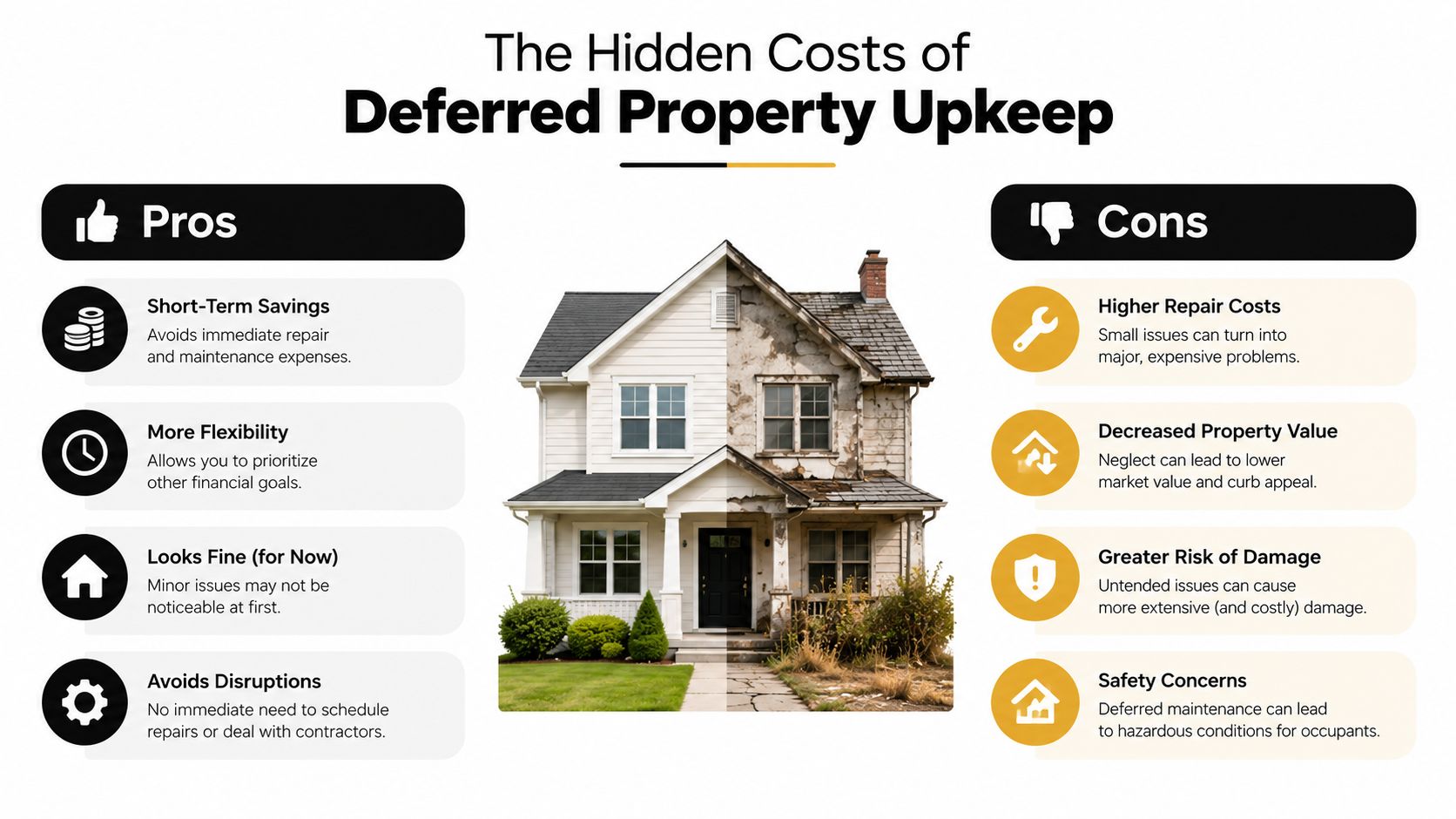
Deferred maintenance usually starts with a reasonable thought: “I'll deal with it when I have more money.” The problem is that a small defect rarely stays small. A loose gutter can send water toward siding and foundations. A slow plumbing leak can wet cabinetry and flooring. A neglected ventilation problem can leave moisture trapped in an attic, crawl space, or bathroom assembly.
The financial pressure is real. A 2025 homeowner survey found that 59% of homeowners postponed necessary repairs because of cost, while 42% ignored maintenance issues because of cost anxiety. Among that latter group, 26% said the problem became worse afterward, according to Frontdoor's home maintenance statistics and checklist. The same survey reported an average of 2 maintenance issues in the prior year, with the most recent issue costing an average of $1,670.
Why delay creates a worse choice
Routine maintenance gives you control over timing, contractor selection, and scope. Emergency repair removes much of that control. You may need immediate service during severe weather, accept temporary measures, replace adjacent materials, or relocate occupants while work takes place.
Safety is the more serious concern. A postponed repair can affect electrical reliability, indoor air quality, stairs, locks, fire detection, or structural components. Recent survey data reported that 60% of homeowners were actively delaying essential maintenance, 71% postponed at least one home project in 2025, and nearly half said their homes felt less safe because of unresolved repairs. The same source put the average cost of deferred projects at about $5,650. These figures are reported by HousingWire's coverage of delayed repairs and safety risks.
The correct response isn't to fix everything immediately. It's to rank work by consequence:
Protect life and safety first. Address fire alarms, carbon monoxide detection, exposed wiring, unsafe stairs, locks, and structural instability.
Stop active water entry next. Leaks and drainage failures can affect concealed areas before damage becomes visible.
Preserve critical systems. HVAC, plumbing, electrical, and water-heating problems can disrupt the entire property.
Handle cosmetic work last. Appearance matters, but paint and finishes shouldn't outrank a failing roof or unsafe electrical component.
Read this practical breakdown of home maintenance cost per year when setting a reserve. The exact amount depends on the property's age, condition, construction, and systems, but the budgeting principle is simple: planned spending is easier to manage than forced spending.
High-Leverage Preventive Tasks for Critical Systems
Two systems deserve immediate attention from every new homeowner: water management and HVAC. Water damages the building envelope and concealed assemblies. HVAC problems reduce comfort, increase mechanical strain, and often appear when the system is needed most.
Start outside and inspect the full water path as one connected system. The roof covering, flashing, gutters, downspouts, grading, and exterior penetrations must work together. A clean gutter won't protect a foundation if the downspout discharges against the wall. Sound siding won't prevent intrusion if flashing is missing around a roof or window.
Control water before it enters
An Oregon maintenance standard calls for annual roof and gutter inspections, twice-yearly caulking and weather-stripping checks, and ventilation fan checks at least every two months. EPA moisture-control guidance recommends semi-annual inspections and extra checks after heavy winds or rain. These schedules are documented in the Oregon maintenance standard for building moisture control.
During each inspection, look for:
- Roof and flashing defects: Lifted materials, open seams, damaged penetrations, and staining below roof intersections.
- Gutter and downspout problems: Sagging sections, overflow marks, blockages, and discharge too close to the foundation.
- Foundation drainage issues: Soil or hardscape that slopes toward the structure, standing water, damp crawl spaces, and efflorescence.
- Sealant failure: Cracked caulk around windows, doors, utility penetrations, and exterior joints.
- Ventilation faults: Bathroom fans that don't exhaust outdoors, blocked vents, and persistent condensation.
Moisture entering a concealed cavity can wet insulation, accelerate decay in wood, corrode metal, and support mold growth. The longer it remains hidden, the more likely repairs will involve removal and reconstruction rather than a localized repair. For plumbing changes or new fixtures, consult qualified specialists familiar with home plumbing installations.
Keep air moving through HVAC equipment
HVAC maintenance follows a similar cause-and-effect chain. A loaded filter increases static pressure, restricts airflow, reduces heat transfer, and can contribute to icing, short-cycling, blower strain, or compressor stress. Blocked vents and dirty coils create the same basic problem, the equipment works harder while delivering less useful heating or cooling.
Industry guidance commonly recommends professional service twice per year and filter replacement about every three months, with more frequent changes in dusty or heavily occupied homes. The relevant guidance is available from SMI Mechanical's ACCA resources. Check filters monthly, keep supply and return vents clear, and confirm that condensate drains are open before the heating and cooling seasons.
Adapting Maintenance Schedules to Climate and Region
A generic checklist is a starting point, not a maintenance plan. The correct schedule depends on what your property experiences. Rain, snow, freezing temperatures, heat, humidity, wind, wildfire smoke, dust, pests, and salt air each place different demands on building materials and equipment.
Regional task patterns show why local planning matters. In the rainy Pacific region, gutter inspections lead the maintenance pattern, while in New England, dryer vent cleaning and smoke and carbon monoxide testing receive greater emphasis. Those findings appear in the Hippo Housepower Report 2026, which also identifies plumbing, appliance breakdowns, and critical system failures as common maintenance concerns.
Build the schedule around local stress
In wet climates, prioritize drainage, roof transitions, gutters, downspouts, crawl-space moisture, exterior sealants, and vegetation near walls. In cold climates, add pipe insulation, freeze protection, weather-stripping, snow-load awareness, and checks for ice-related drainage problems. In hot regions, place more attention on HVAC filters, coil cleanliness, attic ventilation, shading, irrigation, and exterior materials exposed to intense sun.
The home's systems matter as much as the weather. Modern maintenance includes appliances, plumbing fixtures, ventilation fans, water heaters, sump pumps, electrical panels, garage doors, smart controls, and fire safety equipment. A roof-only checklist misses the dryer vent that overheats, the dishwasher supply line that leaks, or the bathroom fan that leaves moisture in the room.
Audit the property before copying a checklist
Walk the property with a notepad and record four conditions:
- Exposure: Identify rain, snow, wind, heat, humidity, dust, salt, or wildfire exposure.
- Age: Record installation dates for the roof, HVAC equipment, water heater, appliances, windows, and major electrical or plumbing work.
- Failure consequence: Mark systems where failure could create immediate safety, water, access, or habitability problems.
- Access and visibility: Note attics, crawl spaces, roof areas, drainage routes, and mechanical equipment that need specialist inspection.
This audit turns regional knowledge into a property-specific plan. A home near mature trees needs a different gutter and roof routine than a treeless desert property. A rental with frequent occupant turnover needs stronger documentation and faster response procedures than a lightly occupied residence.
The 2025 Housepower data reports that 71% of homeowners are focused on preventive maintenance because repair costs are rising, reinforcing the practical direction. Prevention isn't a universal checklist. It's the work that matches the property's climate, construction, occupancy, and failure risks.
Building a Proactive Seasonal Maintenance Calendar
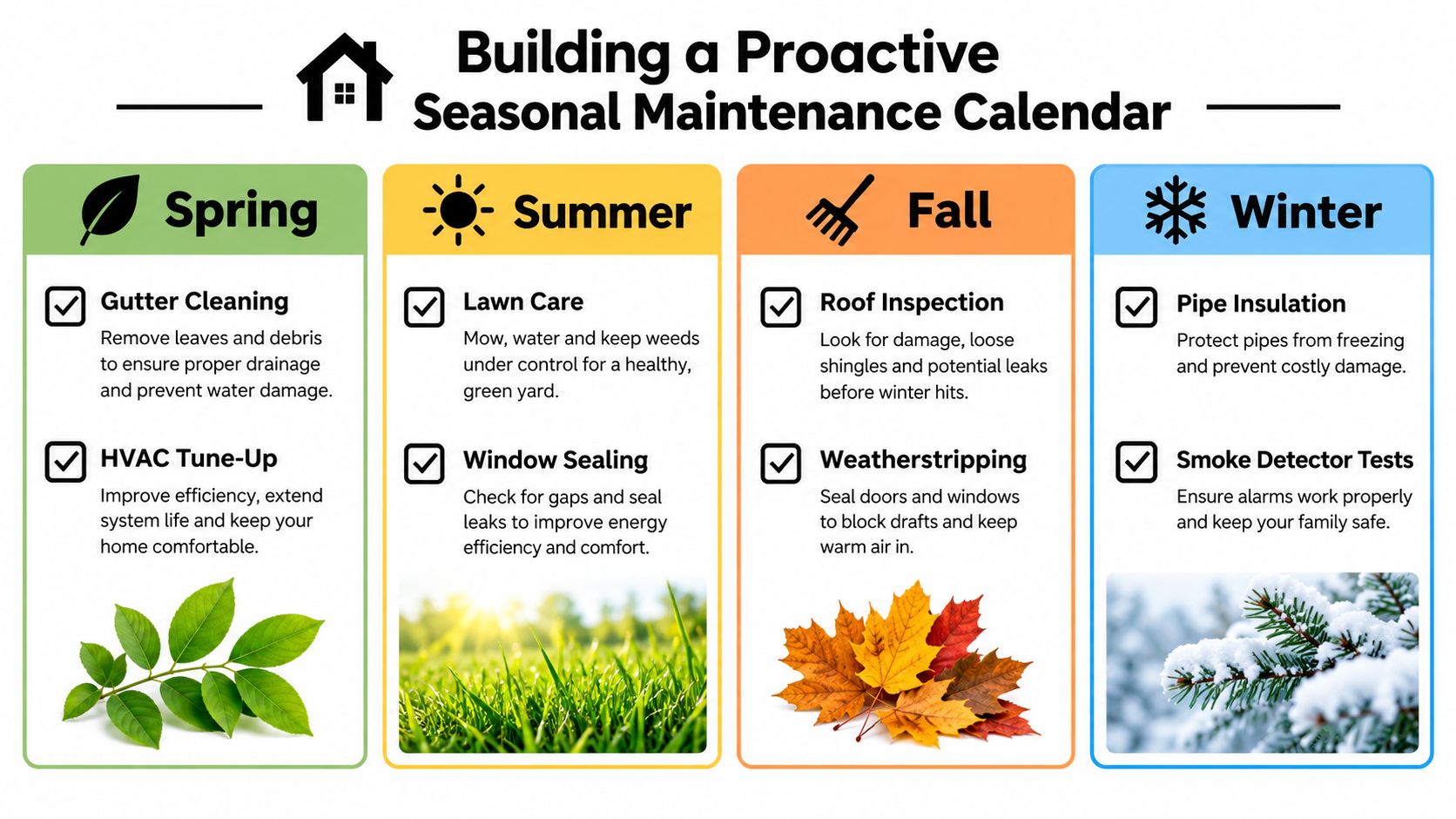
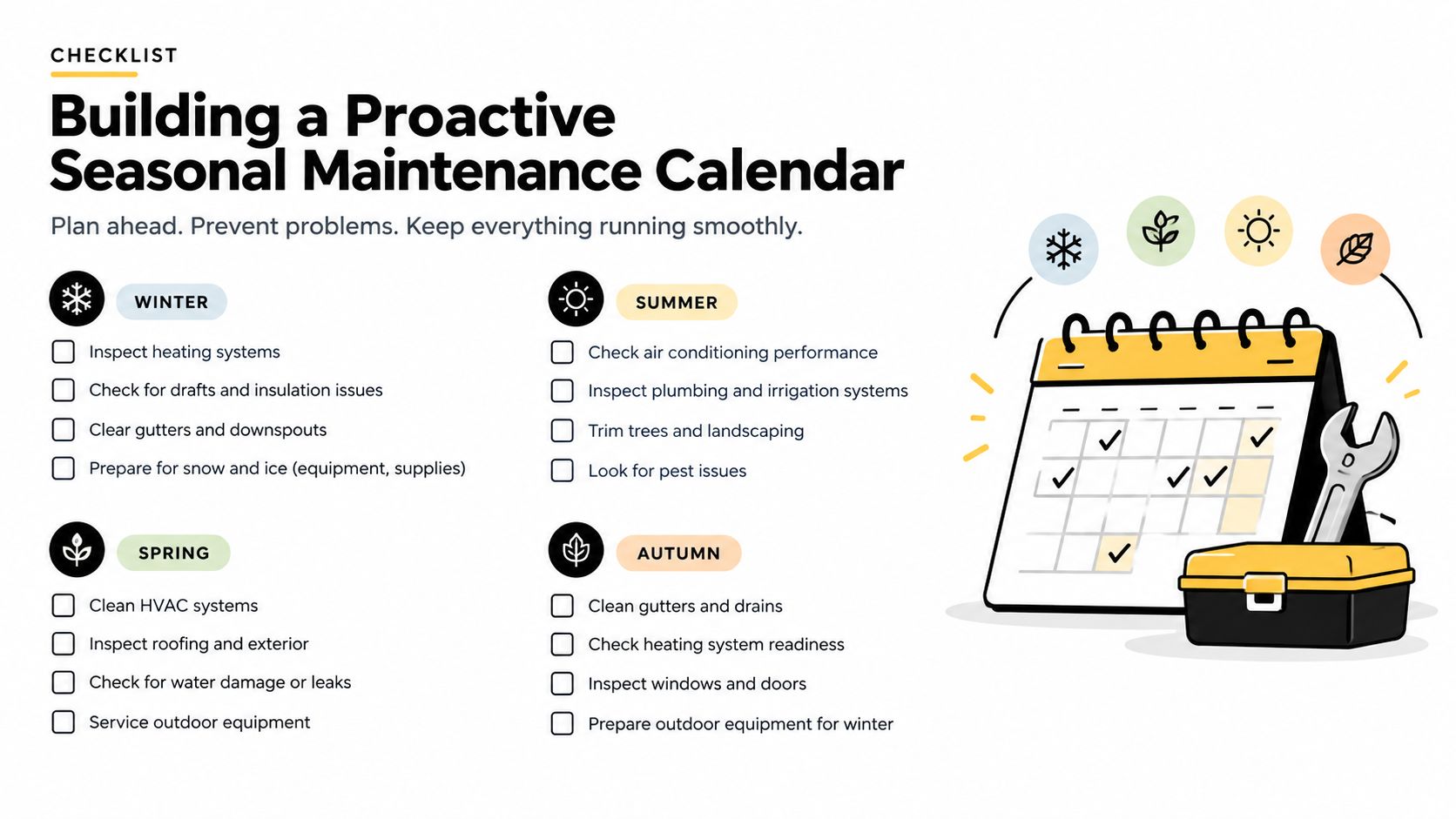
A useful calendar does three things: assigns an owner, gives each task a due period, and records what the inspection found. Without those details, “check the roof” remains an intention rather than a completed maintenance action.
Use three maintenance frequencies
Monthly checks should be short and visual. Look at HVAC filters, leaks beneath sinks, visible pipe corrosion, unusual equipment sounds, smoke and carbon monoxide alarm status, water stains, and blocked drains. Walk exterior drainage routes after rain and confirm that downspouts still discharge away from the structure.
Seasonal work should prepare systems for the conditions ahead. Before cooling season, inspect the air conditioner, condensate drainage, filters, vents, and thermostat. Before heating season, service the furnace, review combustion and ventilation conditions, check filters, and make sure supply and return airflow isn't blocked.
Annual or specialist inspections should address areas that require safe access, technical instruments, or trade knowledge. Schedule roof, flashing, gutter, envelope, HVAC, plumbing, electrical, chimney, and structural reviews according to the property's condition and regional exposure.
Put transitions before peak demand
The best time to discover a heating problem is before cold weather arrives. The best time to find an air-conditioning drainage problem is before the system runs continuously. Seasonal transitions provide a practical inspection window because the equipment is changing from idle or low use to sustained demand.
Record more than “passed” or “failed.” Write down the date, observed condition, photograph location, recommended action, urgency, contractor, and completion date. This record helps identify recurring leaks, aging components, and repair patterns that a single visit can miss.
Use this seasonal home maintenance checklist as a planning aid, then modify it for your house. Keep the calendar in a shared digital document or property management system, set reminders, and attach invoices and photographs to each completed task.
Decide what you should and shouldn't do yourself
You can usually handle visual checks, filter changes, cleaning accessible gutters from a safe position, clearing visible debris, testing alarms, and documenting conditions. Don't climb onto a steep or damaged roof, open energized electrical equipment, work on combustion systems, or diagnose refrigerant problems without the appropriate training and equipment.
A professional inspection is valuable when the cost of missing a defect is high. Paying for qualified eyes at the right time is not unnecessary spending. It's a method of reducing uncertainty before a failure becomes urgent.
Implementing a Professional Property Maintenance Plan
A professional plan begins with a baseline inspection, not a generic bundle of services. The provider documents the property's exterior, interior, mechanical systems, drainage, visible safety concerns, and deferred work. The owner then receives priorities, recommended timing, and a record that can guide future decisions.
Consider a landlord preparing a vacation rental for a demanding season. A casual walkthrough might spot a burned-out bulb and a dripping faucet. A structured inspection also checks the gutter discharge, exterior caulking, HVAC filter and condensate line, water-heater area, appliance connections, smoke and carbon monoxide alarms, locks, handrails, and signs of moisture beneath sinks.
Match professional attention to risk
The plan should distinguish between work that needs immediate action and work that can be scheduled. A blocked downspout before a storm, a failed carbon monoxide alarm, and a cosmetic drywall crack don't belong in the same priority category. Clear documentation makes that distinction visible to owners, tenants, maintenance staff, and contractors.
For residential properties, the service may focus on comfort, moisture, safety, and system reliability. Commercial buildings require attention to occupant traffic, operational continuity, access routes, equipment rooms, tenant responsibilities, and documentation. Vacation rentals add turnover deadlines, guest safety, appliance reliability, and rapid response requirements.
Use one partner when the work expands
Routine preservation often reveals larger projects. A moisture inspection may lead to exterior repairs. An outdated basement may justify a finishing project. A commercial walkthrough may identify the need for tenant improvements. The advantage of a continuing relationship is that the contractor already understands the property's materials, prior repairs, access conditions, and recurring problems.

Ask any provider to explain what the plan includes, what requires a licensed trade, how findings are documented, how urgent issues are escalated, and whether the team serves your property type. A maintenance agreement should make responsibilities clearer, not hide them behind vague promises.
For owners in Orem, Provo, Lehi, American Fork, and Saratoga Springs, Northpoint Construction provides preventive property maintenance for residential homes, commercial buildings, and vacation rentals. Its broader construction services include basement finishings, home remodels, tenant improvements, and custom homes, allowing routine property care and larger improvements to be coordinated when appropriate.
Securing Long-Term Property Value and Comfort
The best maintenance plan is deliberately boring. It catches the loose flashing before the ceiling stains, clears the drain before the HVAC shuts down, tests the alarm before an emergency, and records the condition before a dispute about responsibility.
That consistency protects more than resale appeal. A dry building is more comfortable than a damp one. Stable airflow is more comfortable than a system that short-cycles. Secure doors, functioning alarms, clear walkways, and reliable plumbing improve daily life for occupants while reducing operational disruption for landlords and property managers.
Make the first assessment this week
Walk the property from roofline to foundation and room by room. Photograph visible defects, record the age of major systems, test safety devices, inspect filters and drains, and mark every location where water could enter or collect. Then classify each finding as urgent, seasonal, annual, or cosmetic.
A strong plan has three characteristics:
- It is scheduled: Every recurring task has a date or season.
- It is documented: Photos, invoices, findings, and repairs stay with the property record.
- It is risk-based: Safety, water intrusion, and critical systems outrank appearance.
Maintenance won't eliminate every repair. It will give you earlier information, better timing, and more control over the cost and disruption of ownership. Treat the house as an asset that needs active management, not as a machine you can ignore until it stops working.
Northpoint Construction creates preventive maintenance plans, inspections, repairs, remodels, basement finishings, tenant improvements, and custom construction for residential and commercial properties. Contact Northpoint Construction to assess your property and build a maintenance plan suited to its systems, occupants, and local conditions.